Wed, Aug 19, 2026
| فارسی
Volume 31, Issue 1 (Continuously Updated 2025)
IJPCP 2025, 31(1): 0-0 |
Back to browse issues page




Download citation:
BibTeX | RIS | EndNote | Medlars | ProCite | Reference Manager | RefWorks
Send citation to:


BibTeX | RIS | EndNote | Medlars | ProCite | Reference Manager | RefWorks
Send citation to:
Samandar M, Hossein Sabet F, Borjali A. Relationship Between Negative Perfectionism and Hypervigilance/Inhibition Maladaptive Schemas Mediated by Rumination in Iranian College Students. IJPCP 2025; 31 (1)
URL: http://ijpcp.iums.ac.ir/article-1-4472-en.html
URL: http://ijpcp.iums.ac.ir/article-1-4472-en.html


1- Department of Clinical Psychology, Faculty of Psychology and Educational Sciences, Allameh Tabatabai University, Tehran, Iran.
2- Department of Clinical Psychology, Faculty of Psychology and Educational Sciences, Allameh Tabatabai University, Tehran, Iran. ,Farideh_hosseinsabet@yahoo.com
2- Department of Clinical Psychology, Faculty of Psychology and Educational Sciences, Allameh Tabatabai University, Tehran, Iran. ,
Full-Text [PDF 10721 kb]
(99 Downloads)
| Abstract (HTML) (242 Views)
Full-Text: (11 Views)
Introduction
Perfectionism is highly prevalent within educational systems, since students are continuously engaged in numerous assignments and exams from childhood to adulthood. During this process, students are often encouraged to set excessively high standards for themselves. Negative perfectionism can lead to various psychological issues and maladaptive consequences in students. It is characterized by the setting of unrealistic goals and a refusal to accept personal mistakes. Research has indicated that early maladaptive schemas may be associated with the development of negative perfectionism in students. These schemas include self-defeating emotional and cognitive patterns that are formed during early development and persist throughout life. Early maladaptive schemas are categorized into five broad domains. The fifth domain, hypervigilance/inhibition, involves an excessive emphasis on the suppression of emotions, impulses, and spontaneous behaviors, as well as a rigid adherence to internalized rules and expectations concerning moral behavior, which are often associated with the loss of peace, happiness, self-expression, close relationships, and overall well-being. This domain includes the schemas of negativity/pessimism (NP), emotional inhibition (EI), unrelenting standards/hypercriticalness (US), and punitiveness (PU).
The NP schema reflects a pervasive focus on the negative aspects of life while neglecting its positive and optimistic dimensions. The EI schema involves the excessive suppression of spontaneous emotions, behaviors, and communication in order to avoid rejection, feelings of shame, or loss of control over personal impulses. The US schema represents a core belief that one should strive excessively to meet extremely high-performance standards, often to avoid criticism. Finally, the PU schema is defined by the belief that individuals should be harshly punished for their mistakes and shortcomings.
Existing research suggests that the relationship between maladaptive schemas and perfectionism is not linear, and several mediating variables have been investigated in this context. Rumination may act as a mediating variable in this relationship. It refers to repetitive and conscious thoughts focused on a specific topic that persist even in the absence of external stimuli. Previous studies have demonstrated associations between rumination, negative perfectionism, and maladaptive schemas. Therefore, the present study aims to investigate the mediating role of rumination in the relationship between the hypervigilance/inhibition domain of maladaptive schemas and negative perfectionism in Iranian students, and provide the structural model of the relationships.
Methods
This study employed structural equation modeling (SEM). The study population consisted of all students from the universities in Tehran, Iran, in the academic year 2023-2024. From this population, 379 eligible students were selected using a convenience sampling method and the sample size was determined based on Klein’s theory. The instruments used in this research included the Young schema questionnaire-3rd edition (YSQ-S3) with 90 items, the positive and negative perfectionism scale (PANPS) developed by Terry-Short, and the rumination response scale (RRS) developed by Nolen-Hoeksema and Morrow. Considering all ethical considerations, the questionnaires were distributed randomly among the participants online. After data collection, data analysis was conducted using descriptive and inferential statistics in SPSS software, version 26 and AMOS software, version 24.
Results
The mean age of the participants was 22.76±2.44 years. Among the 379 participants, 73.9% were female and 26.1% were male. In terms of marital status, 91.8% were single and 8.2% were married. Regarding education level, 2.6% had an associate degree, 53.8% had a bachelor’s degree, 42.2% had a master’s degree, and 1.3% had a doctoral degree. The mean scores of the study variables were as follows: Negative perfectionism=13.44±6.42, RSS=14.27±5.41, hypervigilance/inhibition domain=16.54±61.86, NP=5.37±15.97, EI=5.12±13.70, US=4.47±19.06, and PU=5.58±13.14 (Table 1).
The fit indices of the structural model for the sample were examined. The initial model fit indices were found to be inadequate, indicating a need for model modification. The examination of the modified models revealed the following findings:
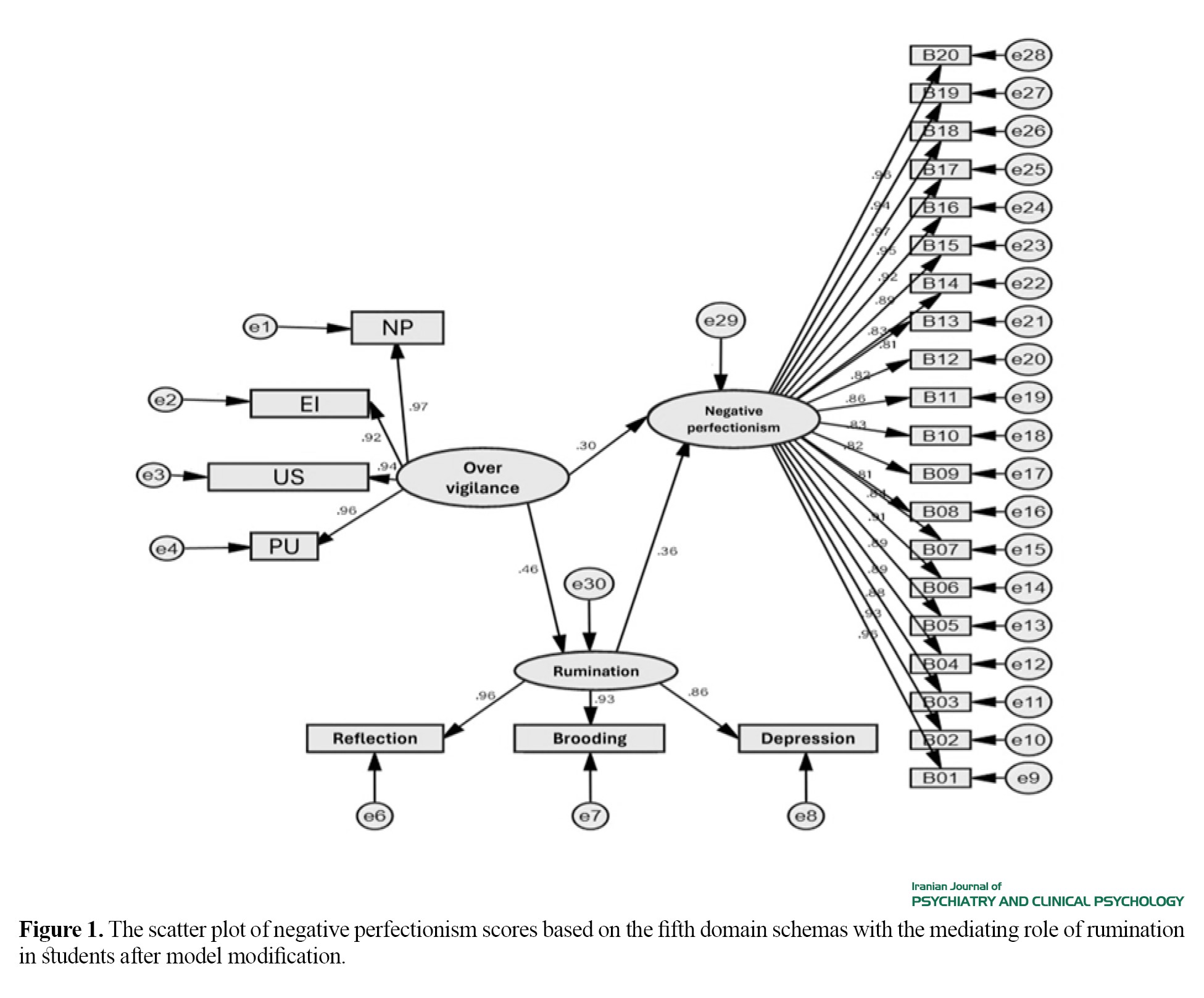
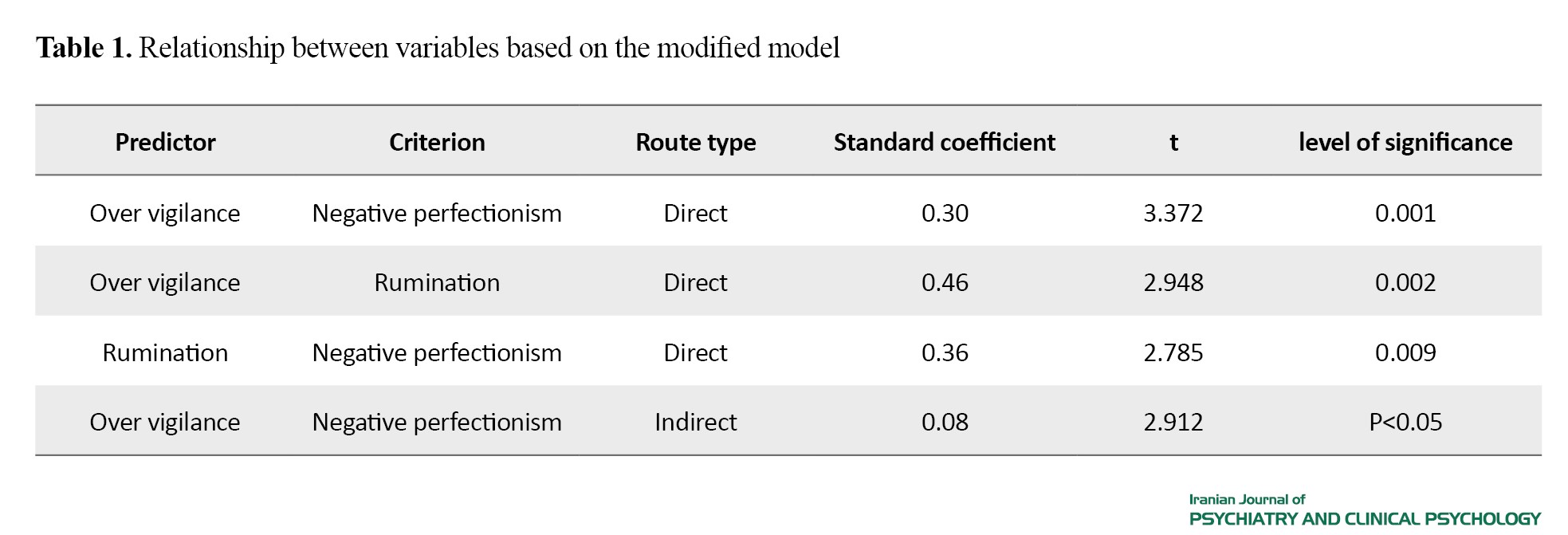
Early maladaptive schemas in the domain of hypervigilance/inhibition directly influenced negative perfectionism and rumination. Moreover, rumination had a direct effect on negative perfectionism. The indirect effect of the hypervigilance/inhibition schemas on negative perfectionism through rumination was calculated as B=-0.08, confirming the mediating role of rumination (Table 1, and Figure 1).
Perfectionism is highly prevalent within educational systems, since students are continuously engaged in numerous assignments and exams from childhood to adulthood. During this process, students are often encouraged to set excessively high standards for themselves. Negative perfectionism can lead to various psychological issues and maladaptive consequences in students. It is characterized by the setting of unrealistic goals and a refusal to accept personal mistakes. Research has indicated that early maladaptive schemas may be associated with the development of negative perfectionism in students. These schemas include self-defeating emotional and cognitive patterns that are formed during early development and persist throughout life. Early maladaptive schemas are categorized into five broad domains. The fifth domain, hypervigilance/inhibition, involves an excessive emphasis on the suppression of emotions, impulses, and spontaneous behaviors, as well as a rigid adherence to internalized rules and expectations concerning moral behavior, which are often associated with the loss of peace, happiness, self-expression, close relationships, and overall well-being. This domain includes the schemas of negativity/pessimism (NP), emotional inhibition (EI), unrelenting standards/hypercriticalness (US), and punitiveness (PU).
The NP schema reflects a pervasive focus on the negative aspects of life while neglecting its positive and optimistic dimensions. The EI schema involves the excessive suppression of spontaneous emotions, behaviors, and communication in order to avoid rejection, feelings of shame, or loss of control over personal impulses. The US schema represents a core belief that one should strive excessively to meet extremely high-performance standards, often to avoid criticism. Finally, the PU schema is defined by the belief that individuals should be harshly punished for their mistakes and shortcomings.
Existing research suggests that the relationship between maladaptive schemas and perfectionism is not linear, and several mediating variables have been investigated in this context. Rumination may act as a mediating variable in this relationship. It refers to repetitive and conscious thoughts focused on a specific topic that persist even in the absence of external stimuli. Previous studies have demonstrated associations between rumination, negative perfectionism, and maladaptive schemas. Therefore, the present study aims to investigate the mediating role of rumination in the relationship between the hypervigilance/inhibition domain of maladaptive schemas and negative perfectionism in Iranian students, and provide the structural model of the relationships.
Methods
This study employed structural equation modeling (SEM). The study population consisted of all students from the universities in Tehran, Iran, in the academic year 2023-2024. From this population, 379 eligible students were selected using a convenience sampling method and the sample size was determined based on Klein’s theory. The instruments used in this research included the Young schema questionnaire-3rd edition (YSQ-S3) with 90 items, the positive and negative perfectionism scale (PANPS) developed by Terry-Short, and the rumination response scale (RRS) developed by Nolen-Hoeksema and Morrow. Considering all ethical considerations, the questionnaires were distributed randomly among the participants online. After data collection, data analysis was conducted using descriptive and inferential statistics in SPSS software, version 26 and AMOS software, version 24.
Results
The mean age of the participants was 22.76±2.44 years. Among the 379 participants, 73.9% were female and 26.1% were male. In terms of marital status, 91.8% were single and 8.2% were married. Regarding education level, 2.6% had an associate degree, 53.8% had a bachelor’s degree, 42.2% had a master’s degree, and 1.3% had a doctoral degree. The mean scores of the study variables were as follows: Negative perfectionism=13.44±6.42, RSS=14.27±5.41, hypervigilance/inhibition domain=16.54±61.86, NP=5.37±15.97, EI=5.12±13.70, US=4.47±19.06, and PU=5.58±13.14 (Table 1).
The fit indices of the structural model for the sample were examined. The initial model fit indices were found to be inadequate, indicating a need for model modification. The examination of the modified models revealed the following findings:
Early maladaptive schemas in the domain of hypervigilance/inhibition directly influenced negative perfectionism and rumination. Moreover, rumination had a direct effect on negative perfectionism. The indirect effect of the hypervigilance/inhibition schemas on negative perfectionism through rumination was calculated as B=-0.08, confirming the mediating role of rumination (Table 1, and Figure 1).
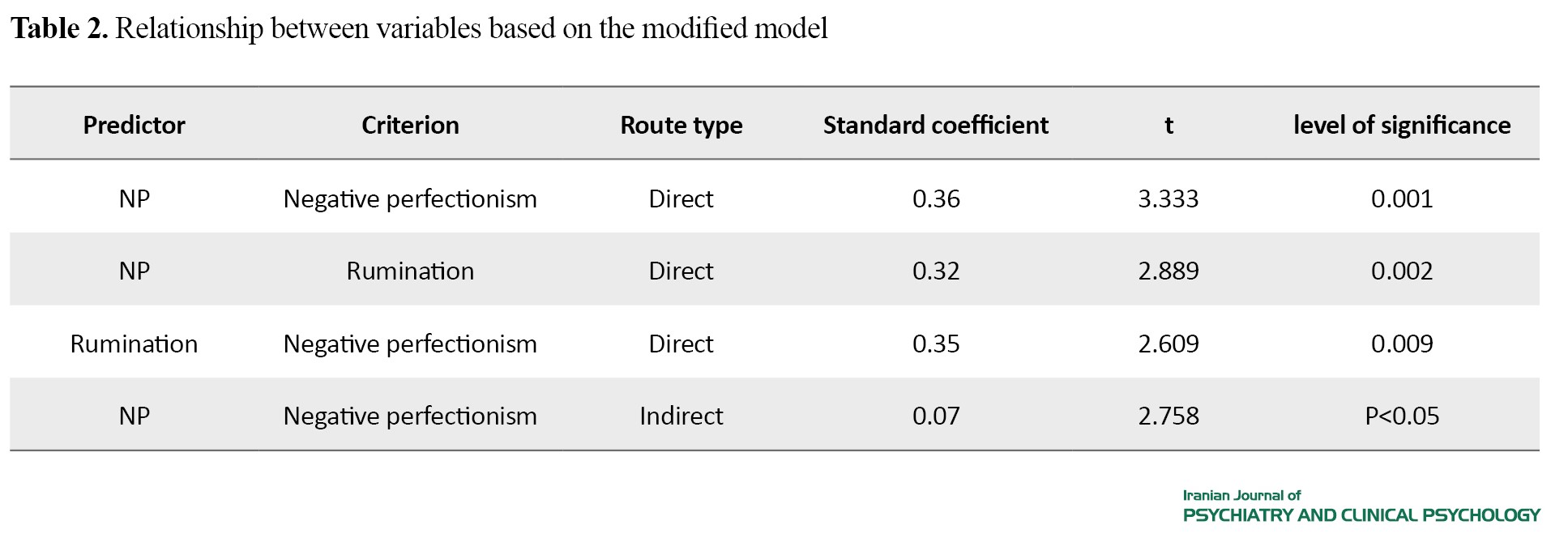
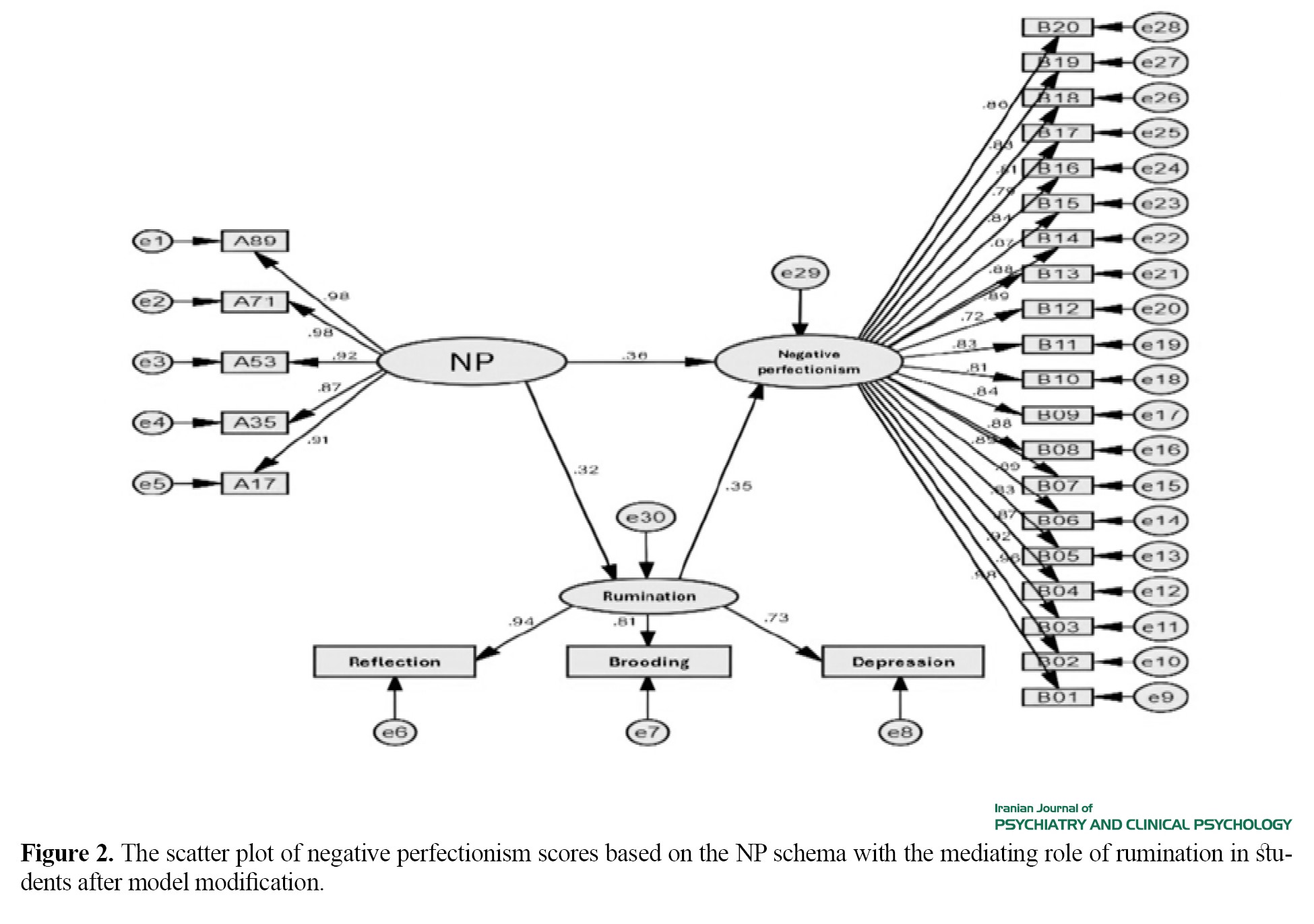
The NP schema directly influenced negative perfectionism and rumination. Additionally, the indirect effect of the NP schema on negative perfectionism through rumination was calculated as B=-0.07, confirming the mediating effect of rumination(Table 2, and Figure 2).
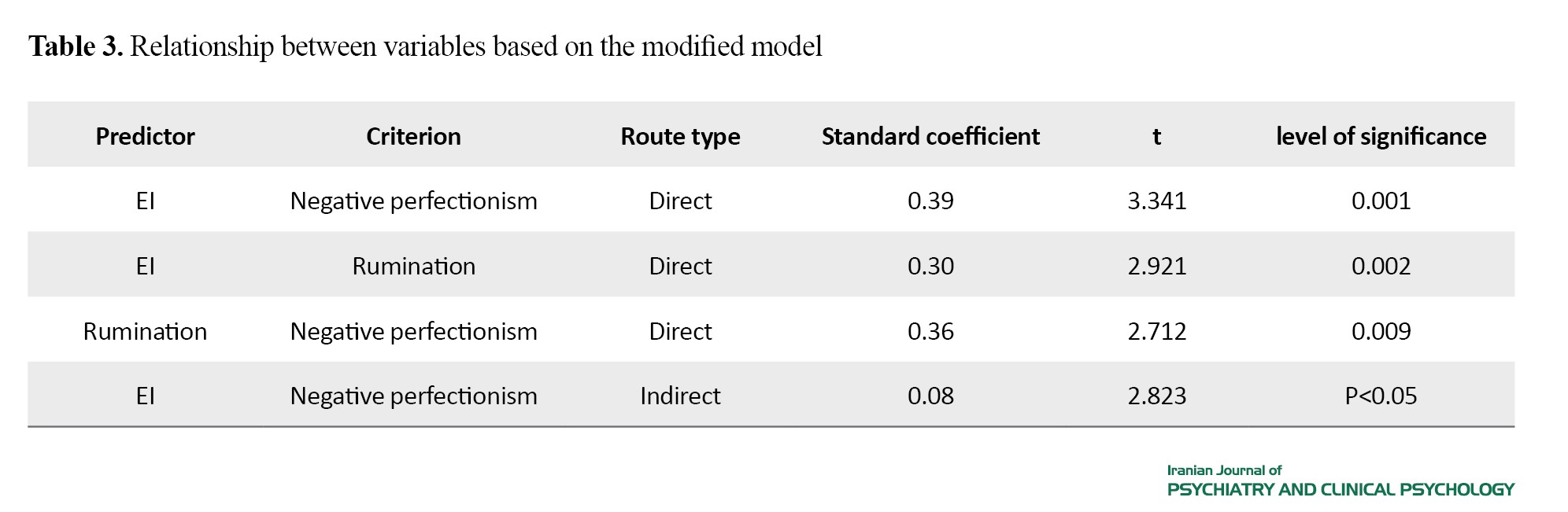
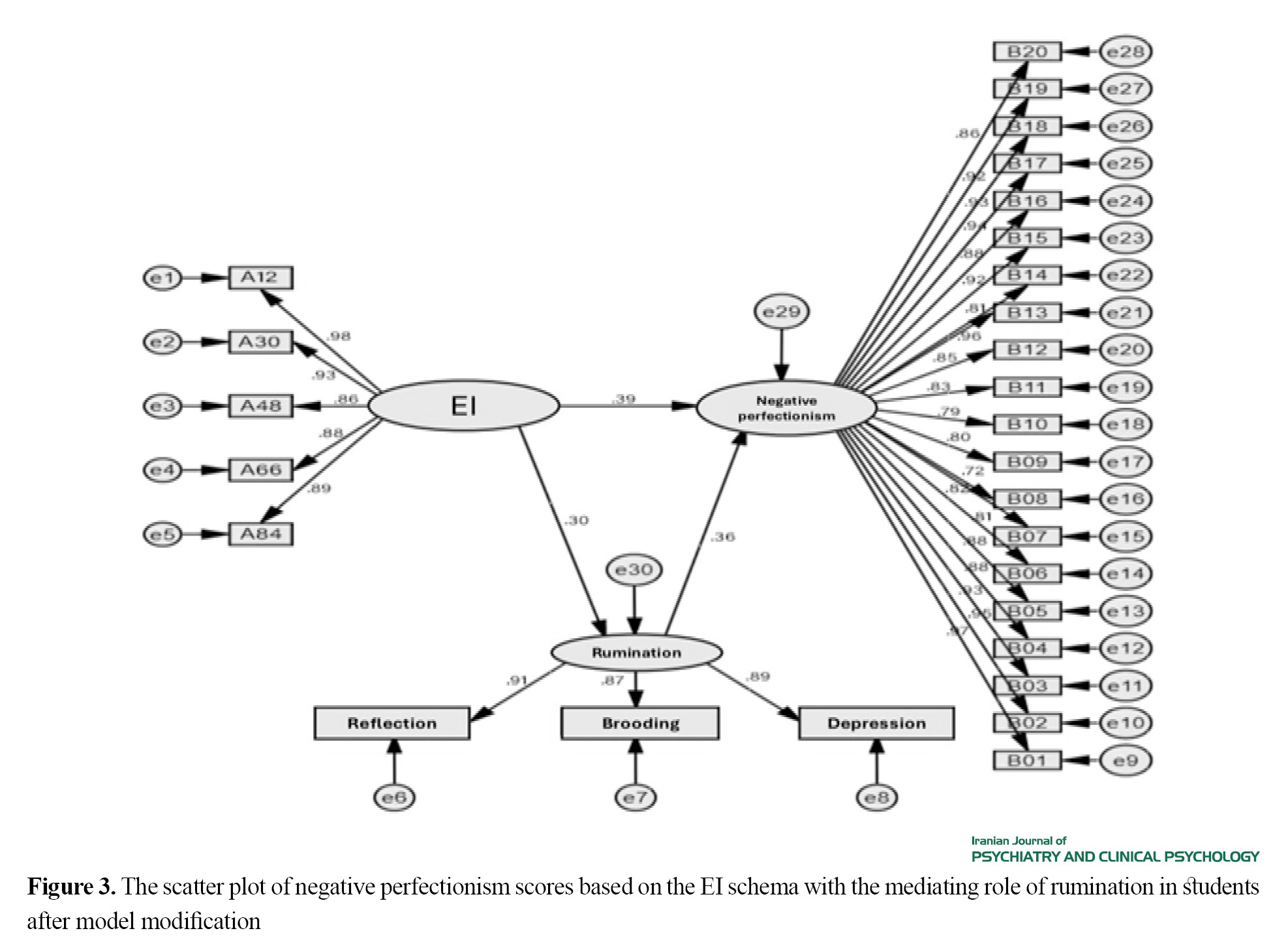
 The EI schema directly influenced negative perfectionism and rumination. Additionally, the indirect effect of the EI schema on negative perfectionism through rumination was calculated as B=-0.08, confirming the mediating effect of rumination (Table 3, and Figure 3).
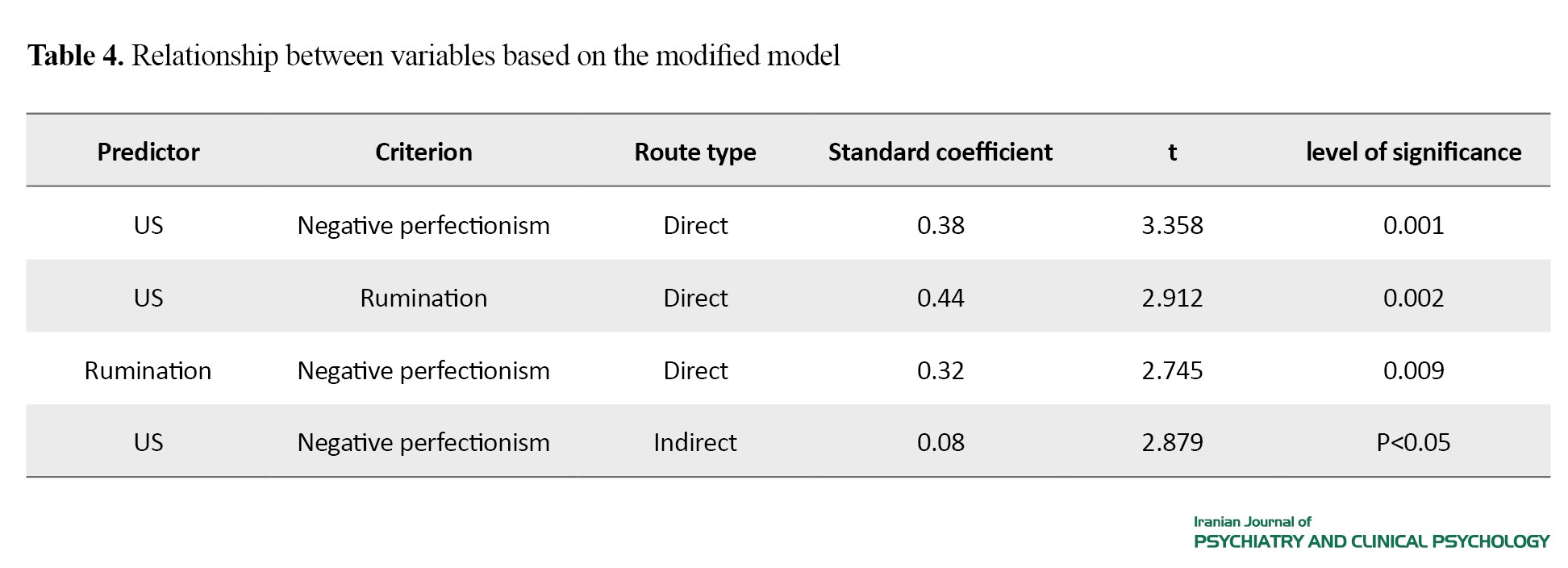
 The US schema directly influenced negative perfectionism and rumination. Additionally, the indirect effect of the US schema on negative perfectionism through rumination was calculated as B=-0.08, confirming the mediating effect of rumination (Table 4).
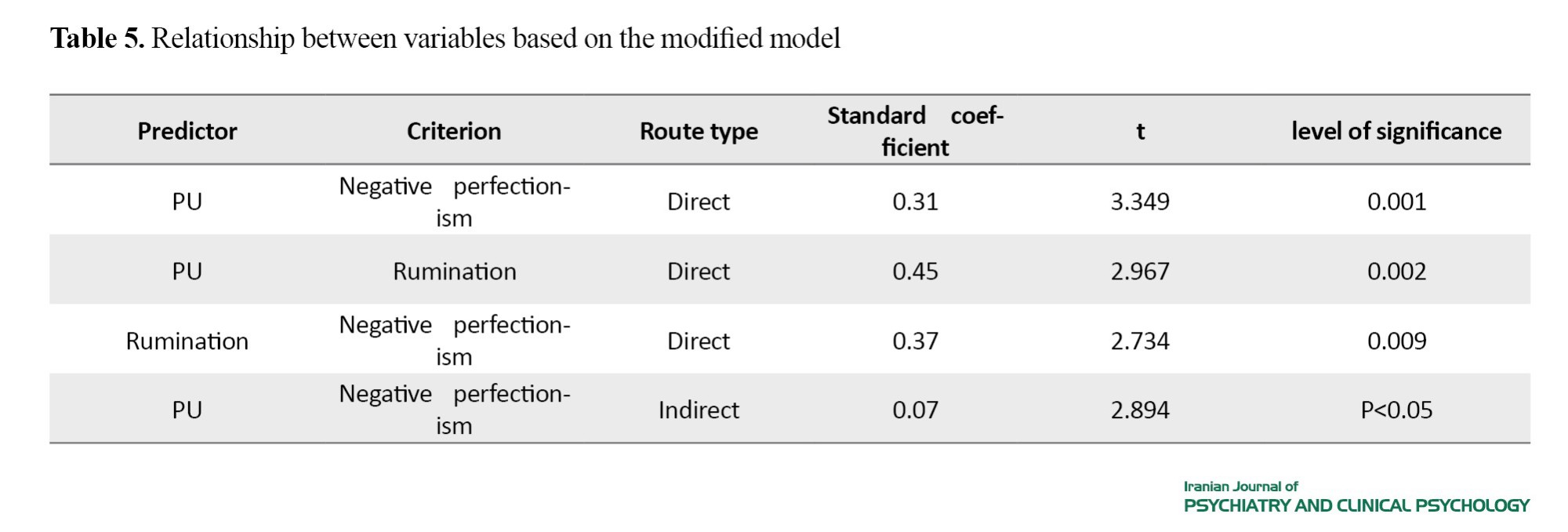
The PU schema directly influenced negative perfectionism and rumination. The indirect effect of the PU schema on negative perfectionism through rumination was calculated as B=-0.07, validating the mediating effect of rumination (Table 5).
Conclusion
The results of the study indicated that negative perfectionism has a direct relationship with the hypervigilance/inhibition schemas in Iranian college students. Also, rumination plays a mediating role in the relationship between the over-vigilance/inhibition schemas and negative perfectionism. This means that these schemas, by increasing rumination, contribute to a more intense manifestation of negative perfectionism. Additionally, the results showed that rumination can mediate the relationship of the NP, EI, US and PU schemas with negative perfectionism separately. Therefore, when rumination is present, the relationship between these schemas and negative perfectionism becomes more pronounced. Therefore, by moderating the levels of these schemas in college students, it is possible to reduce their levels of rumination and negative perfectionism.
Ethical Considerations
Compliance with ethical guidelines
This research was approved by the Research Ethics Committee of Allameh Tabatabai University, Tehran, Iran (Code: IR.ATU.REC.1403.023). All ethical principles were observed in this study, and the personal information of the participants remained confidential.
Funding
This study was extracted from the master’s thesis of Mehrnoush Samandar, approved by the Department of Clinical Psychology, Faculty of Psychology and Educational Sciences, Allameh Tabatabai University, Tehran, Iran. This research did not receive any specific grant from funding agencies in the public, commercial, or not-for profit sectors.
Authors contributions
Conceptualization, investigation, resources, original draft preparation, and methodology: Mehrnoush Samandar; Supervision: Ahmad Borjali; Review & editing: Farideh Hossein Sabet.
Conflicts of interest
The authors declared no conflict of interest.
Acknowledgments
The authors would like to thank all the students who participated in this research for their cooperation and time.
References
The PU schema directly influenced negative perfectionism and rumination. The indirect effect of the PU schema on negative perfectionism through rumination was calculated as B=-0.07, validating the mediating effect of rumination (Table 5).
Conclusion
The results of the study indicated that negative perfectionism has a direct relationship with the hypervigilance/inhibition schemas in Iranian college students. Also, rumination plays a mediating role in the relationship between the over-vigilance/inhibition schemas and negative perfectionism. This means that these schemas, by increasing rumination, contribute to a more intense manifestation of negative perfectionism. Additionally, the results showed that rumination can mediate the relationship of the NP, EI, US and PU schemas with negative perfectionism separately. Therefore, when rumination is present, the relationship between these schemas and negative perfectionism becomes more pronounced. Therefore, by moderating the levels of these schemas in college students, it is possible to reduce their levels of rumination and negative perfectionism.
Ethical Considerations
Compliance with ethical guidelines
This research was approved by the Research Ethics Committee of Allameh Tabatabai University, Tehran, Iran (Code: IR.ATU.REC.1403.023). All ethical principles were observed in this study, and the personal information of the participants remained confidential.
Funding
This study was extracted from the master’s thesis of Mehrnoush Samandar, approved by the Department of Clinical Psychology, Faculty of Psychology and Educational Sciences, Allameh Tabatabai University, Tehran, Iran. This research did not receive any specific grant from funding agencies in the public, commercial, or not-for profit sectors.
Authors contributions
Conceptualization, investigation, resources, original draft preparation, and methodology: Mehrnoush Samandar; Supervision: Ahmad Borjali; Review & editing: Farideh Hossein Sabet.
Conflicts of interest
The authors declared no conflict of interest.
Acknowledgments
The authors would like to thank all the students who participated in this research for their cooperation and time.
References
- Bazargan A. Standards of higher education: From ideal to reality. Nameh Amouzesh Ali. 2015; 30(8):11-22. [Link]
- Kearns H, Forbes A, Gardiner M, Marshall K. When a high distinction isn’t good enough: A review of perfectionism and self-handicapping. Australian Educational Researcher. 2008; 35(3):21-36. [Link]
- Flett GL, Hewitt PL. Perfectionism and maladjustment: An overview of theoretical, definitional, and treatment issues. In: Flett GL, Hewitt PL, editors. Perfectionism: Theory, research, and treatment. Washington: American Psychological Association; 2002. [DOI:10.1037/10458-001]
- Burns DD. The perfectionist’s script for self-defeat. Psychology Today. 1980; 14(6):34-52. [Link]
- Bouchard C, Rhéaume J, Ladouceur R. Responsibility and perfectionism in OCD: An experimental study. Behaviour Research and Therapy. 1999; 37(3):239-48. [DOI:10.1016/S0005-7967(98)00141-7] [PMID]
- Hamachek DE. Psychodynamics of normal and neurotic perfectionism. Psychology: A Journal of Human Behavior. 1978; 15(1):27-33. [Link]
- Schruder CR, Sharpe GW, Curwen T. Perfectionistic students: Contributing factors, impacts and teacher strategies. Journal of Elements Education. 2014; 24(1):79-98. [DOI:10.9734/BJESBS/2014/5532]
- Manouchehri A, Behroozi N, Shahni Yalag M, Makhtabi GH. Testing the model of positive perfectionism and negative life events with coping styles and psychological well-being: The mediating role of psychological capital. Journal of Developmental Psychology. 2019; 15(60):403-17. [Link]
- Qashqaei G, Hossein Sabet F, Motamedi A. [The relationship between negative and positive perfectionism and psychological capital in female students of Allameh Tabatabai University (Persian)]. Journal of Psychology Research and Management. 2021; 7(1):72-89. [Link]
- Mehrpouya A, Fakhri S, Ghaderi Dehrashi B, Kamari N. [The relationship between perfectionism and students' anxiety (Persian)]. Paper presented at: Hamayesh-e Pazhoohesh-haye Modiriat va Olum-e Ensani dar Iran. 5 January 2024; Tehran, Iran. [Link]
- Atadokht S, Ebadi M. The mediating role of academic emotions and psychological well-being in the relationship between perfectionism and academic stress in students. Journal of Applied Psychology Research. 2022; 13(2):283-302. [Link]
- Daneshgu F, Barzegar Bafrui K, Hasani H. Investigating the role of negative perfectionism and experiential avoidance in academic stress with the mediating role of fear of negative evaluation in students at Yazd University. Journal of Academy and Learning and Teaching. 2023. [DOI:10.30473/etl.2023.64123.3801]
- Mansouri K, Ashouri A, Gharaei B, Farahani H. Role of fear of failure, self-compassion, and intolerance of uncertainty as mediators in the relationship between academic procrastination and perfectionism. Iranian Journal of Psychiatry and Clinical Psychology. 2022; 28(1):34-47. [DOI:10.32598/ijpcp.28.1.3706.1]
- Richardson C, Gradisar M. Perfectionism and insomnia in adolescents: The role of vulnerability to stress and gender. Journal of Adolescence. 2020; 85:70-9. [DOI:10.1016/j.adolescence.2020.10.003] [PMID]
- Mohamadhosinitabarnashli M, Nasrolahi B, Ghorbanjahromi R, Salahian A. [The effectiveness of schema therapy on women's self-esteem (Persian)]. Journal of Psychological Science. 2025; 24(149):87-106. [Link]
- Harper KL, Eddington KM, Lunsford J, Hoet AC. Perfectionism and the impact of intrinsic and extrinsic motivation in daily life. Journal of Individual Difference. 2020; 41(3):117–23. [DOI:10.1027/1614-0001/a000310]
- Moeidfar H, Yaghoubi H, Hasani Abadi HR, Mahdavian A. [The correlation of perfectionism and depression in students with the mediating role of rumination (Persian)]. Journal of Health Promotion Management. 2018; 7(6):1-8. [Link]
- Mahmoudzadeh R, Mohammadkhani S. [Perfectionism and Academic Procrastination: The mediating role of rumination (Persian)]. Clinical Psychology and Personality. 2020; 14(1):125-34. [Link]
- Karami J, Hatamian P. [The relationship between self-efficacy and perfectionism with academic burnout in students (Persian)]. Pajoohande. 2017; 21(4):186-91. [Link]
- Soliemanifar O. [The mediating role of self-efficacy beliefs (general and social) on the relationship between negative self-statements and social anxiety (Persian)]. International Journal of Behavior Sciences. 2015; 9(1):85-94. [Link]
- Klein RG, Dooley D, Lapierre K, Pitura VA, Adduono D. Trait perfectionism and competitiveness: conceptual similarities and differences in a lab-based competitive task. Personal Individual Differences. 2020; 153:109610. [DOI:10.1016/j.paid.2019.109610]
- Hashemi Golestan NS, Aghamohammadian Shahrebaf HR, Moienizadeh M. [Investigating the role of maladaptive schemas and personality traits in predicting students’ relational patterns with the mediating role of perfectionism (Persian)]. Medical Journal of Mashhad university of Medical Sciences. 2020; 62(5.1): 834-51. [DOI:10.22038/mjms.2020.15682]
- Jajarmi M, Zahmatkesh M. Comparison of metacognitive beliefs and perfectionism in individuals with obsessive-compulsive disorder and normal individuals. Educantion Research Journal. 2015; 43(10):25-36.
- Dozois DJA, Beck AT. Cognitive schemas, beliefs, and assumptions. In: Dobson KS, Dozois SJA, editors. Risk factors in depression. Amsterdam: Elsevier; 2008. [DOI:10.1016/B978-0-08-045078-0.00006-X]
- Young JE, Klosko JS, Weishaar ME. Schema therapy: A practitioner’s guide. New York: Guilford Press; 2003. [Link]
- Beck JS. Cognitive behavior therapy: Basics and beyond. New York: Guilford Publications; 2020. [Link]
- Klibert J, Lamis DA, Naufel K, Yancey CT, Lohr S. Associations between perfectionism and generalized anxiety: Examining cognitive schemas and gender. Journal of Ration Emotion Cognitive Behavior Therapy. 2015; 33:160-78. [DOI:10.1007/s10942-015-0208-9 ]
- Pourshahbaz A, Moloodi R, Mohammadkhani P, Fata L, Barani M, Egan SJ, Ghaderi A. An etiological and maintenance model of perfectionism. 2022. [Preprint] [DOI:10.21203/rs.3.rs-1235520/v1]
- Azizi Z, Naderian M. [Explaining the causal relationship between early maladaptive schemas and fear of negative appearance evaluation in cosmetic surgery applicants based on the mediating role of perfectionism (Persian)]. Journal of Psychiatry Nursing. 2024; 12(1):111-26. [Link]
- Sakhai Ardakani Z, Nikdel F, Taghvaei Nia A. [The effectiveness of schema therapy on rumination and procrastination in students (Persian)]. Journal of Modern Psychology Research. 2023; 18(70):107-14. [Link]
- Salmanpour H, Farid A, Salmanpour S, Ghasemzadeh A. [The relationship between early maladaptive schemas and perfectionism: Testing a causal model (Persian)]. Journal of Modern Psychological Researches. 2014; 9(35):81-97. [Link]
- Martin LL, Tesser A. Toward a motivational and structural theory of ruminative thought. In: Uleman JS, Bargh JA, editors. Unintended thought. New York: The Guilford Press; 1989. [Link]
- Amberly KP, Daphne AD, Amanda MR, Nicole AS, Norman BS. The role of cognitive processes of rumination. Personal Individual differences. 2015; 86:277-81. [DOI:10.1016/j.paid.2015.06.024]
- Cowdrey FA, Park RJ. The role of experiential avoidance, rumination, and mindfulness in eating disorders. Eating Behaviors. 2012; 13(2):100-5. [DOI:10.1016/j.eatbeh.2012.01.001] [PMID]
- Hill RW, Huelsman TJ, Furr RM, Kibler J, Vicente BB, Kennedy C. A new measure of perfectionism: The perfectionism inventory. Journal of Personality Assessment. 2004; 82(1):80-91. [DOI:10.1207/s15327752jpa8201_13] [PMID]
- Salari F, Moeinizadeh M, Asghari Ebrahimabad J. [The role of perfectionism in predicting marital satisfaction in married individuals with the mediating role of rumination (Persian)]. Research in Clinical Psychology and Counseling. 2024; 13(2):5-20. [DOI:10.22067/tpccp.2024.81682.1477]
- Ramezanpour F, Jouzi H. [Structural model of self-critical perfectionism and symptoms of depression, anxiety, and stress: The mediating role of experiential avoidance and rumination (Persian)]. Contemp Psychology. 2020; 15(2):33-48. [Link]
- Zarei S, Fouladvand A. [The relationship between self-esteem and maladaptive perfectionism with work addiction among healthcare workers: The mediating role of rumination (Persian)]. Iranian Journal of Psychiatric Nursing. 2022; 9(6):75-85. [Link]
- Moein M, Farahanifar M. [The effectiveness of schema therapy with an emphasis on schema modes on rumination and perfectionism in individuals with treatment-resistant obsessive-compulsive disorder (Persian)]. Rooyesh-e-Ravanshenasi Journal. 2024; 13(4):135-44. [Link]
- Memarzadeh L, Abdollahi A, Hosseinian S. [Investigating the structural relationships between perfectionism and rumination in women: The moderating role of psychological flexibility (Persian)]. Quarterly Journal of Psychological Studies. 2025; 21(3):7-23. [Link]
- Amirkalali S, Samari AA, Teymouri S, Saghaebi A. [Modeling Structural Equations of Psychological Well-being in Migraine Patients based on Perfectionism and Rumination with the Mediation Role of Negative Affect (Persian)]. Journal of Mashhad Univercity Medical Sciences. 2024; 67(2):478-93. [DOI:10.22038/mjms.2024.76901.4485]
- Zahn-Waxler C, Crick NR, Shirtcliff EA, Woods KE. The origins and development of psychopathology in females and males. In: Cicchetti D, Cohen DJ, editors. Developmental psychopathology: Volume one: Theory and method. 2nd ed. Hoboken: Wiley; 2015. 76-138. [DOI:10.1002/9780470939383.ch4]
- Torajizadeh M, Mohammadijalali F, Taghvae D. Comparison of the effects of functional analytic psychotherapy and schema therapy on emotional experiences with spouses, communication patterns, and rumination in couples. Applied Family Therapy. 2023; 4(5):173-91. [DOI:10.61838/kman.aftj.4.5.10]
- Khadem F, Emadian M, Alia S. Effectiveness of schema therapy on rumination, perfectionism, and thought-action fusion in women with obsessive-compulsive disorder. Applied Family Therapy. 2021; 2(1):541-65. [DOI:10.61838/kman.aftj.2.1.29]
- Pirayeh L, Bagooli H, Hosseini SE, Borzger M. Comparing emotional schema-based therapy and schema therapy in reducing rumination in patients with persistent depressive disorder (dysthymia). Journal of Affective Disorders. 2021; 11:124. [Link]
- Anayurt A, Yalçın İ. Investigation of relations between emotion regulation, early maladaptive schemas, cognitive flexibility, and rumination. Kastamonu Education Journal. 2021; 29(4):194-204. [DOI:10.24106/kefdergi.818048]
- Mehrabinia F, Shamsaee MM. [Examination of the association between early maladaptive schemas and anger rumination in students based on gender (Persian)]. Iranian Journal of Psychiatric Nursing. 2019; 6(1):1-8. [Link]
- Carlucci L, D’ambrosio I, Innamorati M, Saggino A, Balsamo M. Co-rumination, anxiety, and maladaptive cognitive schemas: when friendship can hurt. Psychology Research and Behavior Management. 2018; 11:133-144. [DOI:10.2147/PRBM.S144907] [PMID]
- Leahy RL. Emotional schema therapy: A bridge over troubled waters. In: Herbert JD, Forman EM, editors. Acceptance and mindfulness in cognitive behavior therapy: Understanding and applying new therapies. New Jersey: John Wiley & Sons; 2011. [DOI:10.1002/9781118001851.ch5]
- Nepon T, Flett GL, Hewitt PL, Molnar DS. Perfectionism, negative social feedback, and interpersonal rumination in depression and social anxiety. Canadian Journal of Behavioural Science. 2011; 43(4):297. [DOI:10.1037/a0025032]
- Taghvaeinia A, Rahimian Bogar E, Karani M. [The effectiveness of cognitive-behavioural coaching on negative prefectionism and scholastic self-handicapping among students (Persian)]. Journal of Research in Educational Science. 2019; 13(46):95-110. [Link]
- Habibi A, Adnoor M. [Structural equation modeling and factor analysis (Persian)]. Tehran: Jahad Daneshgahi Publications; 2017. [Link]
- Kline RB. Principles and practice of structural equation modeling. New York: Guilford Publications; 2023. [Link]
- Young JE, Brown G. Young schema questionnaire-short form; Version 3. Psychological Assessment. 2005. [DOI:10.1037/t67023-000]
- Young JE. Klosko JS, Weishaar ME.Schema therapy: A practitioner’s guide. New York: Guilford Press; 2003. [Link]
- Schmidt NB, Joiner TE, Young JE, Telch MJ. The schema questionnaire: Investigation of psychometric properties and the hierarchical structure of a measure of maladaptive schemas. Cognitive Therapy and Research. 1995; 19:295-321. [DOI:10.1007/BF02230402]
- Ahi G, Mohamadifar M, Besharat MA. [Validating of the early maladaptive schema scale (short form) (Persian)]. Journal of Psychology & Education. 2007; 37(3):5-20. [Link]
- Yoosefi N, Etemadi O, Bahrami F, Fatehizade MA, Ahmadi SA. An investigation on early maladaptive schema in marital relationships as predictors of divorce. Journal of Divorce Remarriage. 2010; 51(5):269-92. [DOI:10.1080/10502551003651951]
- Terry-Short L, Owens RG, Slade PD, Dewey ME. Positive and negative perfectionism. Personal Individual Difference. 1995; 18(5):663-78. [DOI:10.1016/0191-8869(94)00192-U]
- Besharat MA. Evaluating psychometric properties of Farsi version of the positive and negative perfectionism scale. Psychology Report. 2005; 97(1):33-42. [DOI:10.2466/pr0.97.1.33-42] [PMID]
- Haase AM, Prapavessis H. Assessing the factor structure and composition of the positive and negative perfectionism scale in sport. Personal Individual Difference. 2004; 36(7):1725-40. [DOI:10.1016/j.paid.2003.07.013]
- Nolen-Hoeksema S, Morrow J. A prospective study of depression and posttraumatic stress symptoms after a natural disaster: The 1989 loma prieta earthquake. Journal of Personal Society Psychology. 1991; 61(1):115. [DOI:10.1037//0022-3514.61.1.115] [PMID]
- Mansouri A, Bakhshipour RA, Mahmoud M, Farnam A, Fakhari A. [The comparison of worry, obsession and rumination in individuals with generalized anxiety disorder, obsessive-compulsive disorder, major depression disorder, and normal individuals (Persian)]. Journal of Psychological Studies. 2011; 7(4):55-74. [DOI:10.22051/psy.2011.1535]
- Meyers LS, Gamst G, Guarino AJ. Applied multivariate research: Design and interpretation. New York: Sage Publications; 2016. [DOI:10.4135/9781071802687]
- Sobel ME. Asymptotic confidence intervals for indirect effects in structural equation models. Sociological Methodology. 1982; 13:290-312. [DOI:10.2307/270723]
Type of Study: Original Research |
Subject:
Psychiatry and Psychology
Received: 2025/03/15 | Accepted: 2025/12/9 | Published: 2025/08/1
Received: 2025/03/15 | Accepted: 2025/12/9 | Published: 2025/08/1
| Rights and permissions | |
 |
This work is licensed under a Creative Commons Attribution-NonCommercial 4.0 International License. |

Copyright © The Author(s);
This is an open access article distributed under the terms of the Creative Commons Attribution License (CC-By-NC), which permits use, distribution, and reproduction in any medium, provided the original work is properly cited and is not used for commercial purposes.
Contact Information