Wed, Aug 19, 2026
| فارسی
Volume 31, Issue 1 (Continuously Updated 2025)
IJPCP 2025, 31(1): 0-0 |
Back to browse issues page




Download citation:
BibTeX | RIS | EndNote | Medlars | ProCite | Reference Manager | RefWorks
Send citation to:


BibTeX | RIS | EndNote | Medlars | ProCite | Reference Manager | RefWorks
Send citation to:
Mohammadi E, Bakhshipour Roudsari A, Mahmoud Alilou M, Ranjbar F. The Role of Executive Functions in Differentiation Between Children With Cognitive Disengagement Syndrome and Attention Deficit/Hyperactivity Disorder. IJPCP 2025; 31 (1)
URL: http://ijpcp.iums.ac.ir/article-1-4450-en.html
URL: http://ijpcp.iums.ac.ir/article-1-4450-en.html


1- Department of Clinical Psychology, Faculty of Education and Psychology, University of Tabriz, Tabriz, Iran.
2- Department of Psychology, Faculty of Education and Psychology, University of Tabriz, Tabriz, Iran. ,bakhshipour@tabrizu.ac.ir
3- Department of Psychology, Faculty of Education and Psychology, University of Tabriz, Tabriz, Iran.
4- Department of Psychiatry, Faculty of Medicine, Tabriz University of Medical Science, Tabriz, Iran.
2- Department of Psychology, Faculty of Education and Psychology, University of Tabriz, Tabriz, Iran. ,
3- Department of Psychology, Faculty of Education and Psychology, University of Tabriz, Tabriz, Iran.
4- Department of Psychiatry, Faculty of Medicine, Tabriz University of Medical Science, Tabriz, Iran.
Keywords: Attention deficit/hyperactivity disorder (ADHD), Cognitive disengagement syndrome (CDS), Executive functions
Full-Text [PDF 6057 kb]
(146 Downloads)
| Abstract (HTML) (390 Views)
Full-Text: (119 Views)
Introduction
The cognitive disengagement syndrome (CDS) is characterized by symptoms such as daydreaming, mental confusion and fogginess, slowed behaviour, and drowsiness. The results of studies have demonstrated that CDS is internally consistent, generally stable over time, and likely heritable; highly comorbid with attention deficit/hyperactivity disorder (ADHD) in clinical symptoms related to attention and concentration; and is associated with poorer functioning across a number of executive domains. These findings raise the possibility that the use of executive functions can help to differentiate the children with CDS and ADHD. In this regard, the present study aimed to investigate the discrimination role of executive functions in differentiation of children with CDS and ADHD.
Methods
This is a descriptive cross-sectional study with a two-group discriminant function design. The study population consists of all children aged 8-12 years with CDS or ADHD, living in Tabriz, Iran, in 2023-2024. From this population, 75 children with CDS and 75 children with ADHD were selected by purposeful sampling method and using diagnostic tools including structured clinical interview, sluggish cognitive tempo scale (SCTS) and teacher and parent rating scale (SNAP-IV). Inclusion criteria were age 8-12 years, having average IQ, not suffering from other neurodevelopmental disorders or psychiatric problems, no chronic physical diseases, and the consent of the parents and the child to participate in the research. The exclusion criteria were non-cooperation in conducting the research and taking any medication prescribed by the psychiatrist on the day of the study. After selecting the subjects, The Delis-Kaplan executive function system test was implemented individually on each sample. For data analyses, discriminant analysis was performed in SPSS software, version 24.
Results
The mean age of the children was 8.79±0.76 in the CDS group and 8.56±0.84 in ADHD group. Also, 73 participants were girls (38 in the CDS group and 35 in the ADHD group) and 77 were boys (37 in the CDS group and 40 in the ADHD group). The results of the t-test to compare the groups based on age (P=0.085) and the results of the chi-squared test to compare the groups based on gender (P=0.624) indicated no significant difference between the two groups. Descriptive statistics of the study variables in the two groups are presented in Table 1.
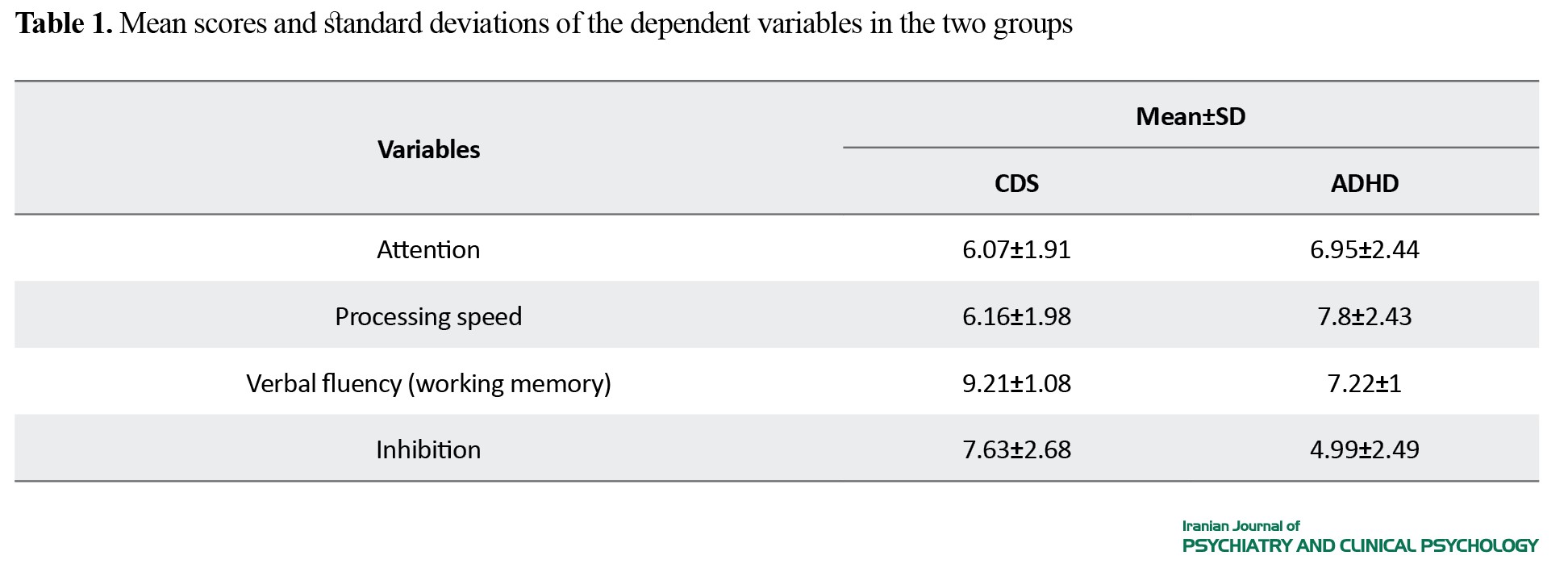
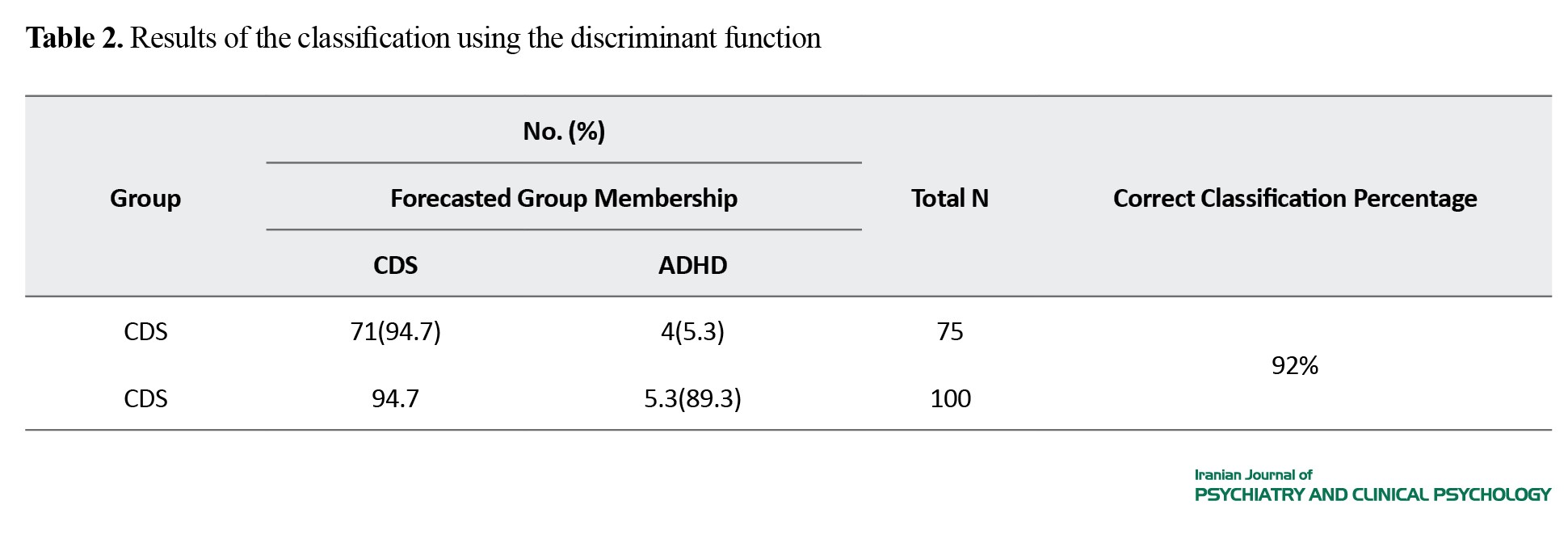
The results in Table 1 showed that the mean scores of attention and processing speed in children with ADHD were higher than in children with CDS. On the other hand, the mean scores of verbal fluencies (working memory) and inhibition of children with CDS were higher than that of children with ADHD. There were significant differences between two groups in terms of attention (F=6.05; P=0.015), processing speed (F=20.5; P<0.001), working memory (F=137.22; P<0.001), and inhibition (F=39.13; P<0.001). The results of the discriminant analysis showed that the discriminant function in 92% correctly differentiated between children with CDS and ADHD (Table 2).
Conclusion
The results showed that using executive functions (attention, processing speed, working memory and inhibition) can help to significantly distinguish children with CDS from those with ADHD. In explaining this finding, Due to the different cognitive profile of children with CDS and ADHD children, the role of executive functions in differentiating these children seems reasonable. Therefore, it is recommended that these executive functions be used as diagnostic measures in clinical settings for children.
Ethical Considerations
Compliance with ethical guidelines
Ethical considerations such as informed consent of the participants and the confidentiality of their information were considered in this research. This study was approved by Research Ethics Committees of University of Tabriz, Tabriz, Iran (Code: IR.TABRIZU.REC.1403.140).
Funding
This article was a extracted from PhD dissertation master's thesis of Elnaz Mohammadi, Clinical Psychology, University of Tabriz and, This research did not receive any specific grant from funding agencies in the public, commercial, or not-for profit sectors
Authors contributions
All authors contributed equally to the conception and design of the study, data collection and analysis, interception of the results and drafting of the manuscript. Each author approved the final version of the manuscript for submission.
Conflicts of interest
The authors declared no conflict of interest.
Acknowledgments
The authors would like to thank all participants for their cooperation in this study.
References
The cognitive disengagement syndrome (CDS) is characterized by symptoms such as daydreaming, mental confusion and fogginess, slowed behaviour, and drowsiness. The results of studies have demonstrated that CDS is internally consistent, generally stable over time, and likely heritable; highly comorbid with attention deficit/hyperactivity disorder (ADHD) in clinical symptoms related to attention and concentration; and is associated with poorer functioning across a number of executive domains. These findings raise the possibility that the use of executive functions can help to differentiate the children with CDS and ADHD. In this regard, the present study aimed to investigate the discrimination role of executive functions in differentiation of children with CDS and ADHD.
Methods
This is a descriptive cross-sectional study with a two-group discriminant function design. The study population consists of all children aged 8-12 years with CDS or ADHD, living in Tabriz, Iran, in 2023-2024. From this population, 75 children with CDS and 75 children with ADHD were selected by purposeful sampling method and using diagnostic tools including structured clinical interview, sluggish cognitive tempo scale (SCTS) and teacher and parent rating scale (SNAP-IV). Inclusion criteria were age 8-12 years, having average IQ, not suffering from other neurodevelopmental disorders or psychiatric problems, no chronic physical diseases, and the consent of the parents and the child to participate in the research. The exclusion criteria were non-cooperation in conducting the research and taking any medication prescribed by the psychiatrist on the day of the study. After selecting the subjects, The Delis-Kaplan executive function system test was implemented individually on each sample. For data analyses, discriminant analysis was performed in SPSS software, version 24.
Results
The mean age of the children was 8.79±0.76 in the CDS group and 8.56±0.84 in ADHD group. Also, 73 participants were girls (38 in the CDS group and 35 in the ADHD group) and 77 were boys (37 in the CDS group and 40 in the ADHD group). The results of the t-test to compare the groups based on age (P=0.085) and the results of the chi-squared test to compare the groups based on gender (P=0.624) indicated no significant difference between the two groups. Descriptive statistics of the study variables in the two groups are presented in Table 1.
The results in Table 1 showed that the mean scores of attention and processing speed in children with ADHD were higher than in children with CDS. On the other hand, the mean scores of verbal fluencies (working memory) and inhibition of children with CDS were higher than that of children with ADHD. There were significant differences between two groups in terms of attention (F=6.05; P=0.015), processing speed (F=20.5; P<0.001), working memory (F=137.22; P<0.001), and inhibition (F=39.13; P<0.001). The results of the discriminant analysis showed that the discriminant function in 92% correctly differentiated between children with CDS and ADHD (Table 2).
Conclusion
The results showed that using executive functions (attention, processing speed, working memory and inhibition) can help to significantly distinguish children with CDS from those with ADHD. In explaining this finding, Due to the different cognitive profile of children with CDS and ADHD children, the role of executive functions in differentiating these children seems reasonable. Therefore, it is recommended that these executive functions be used as diagnostic measures in clinical settings for children.
Ethical Considerations
Compliance with ethical guidelines
Ethical considerations such as informed consent of the participants and the confidentiality of their information were considered in this research. This study was approved by Research Ethics Committees of University of Tabriz, Tabriz, Iran (Code: IR.TABRIZU.REC.1403.140).
Funding
This article was a extracted from PhD dissertation master's thesis of Elnaz Mohammadi, Clinical Psychology, University of Tabriz and, This research did not receive any specific grant from funding agencies in the public, commercial, or not-for profit sectors
Authors contributions
All authors contributed equally to the conception and design of the study, data collection and analysis, interception of the results and drafting of the manuscript. Each author approved the final version of the manuscript for submission.
Conflicts of interest
The authors declared no conflict of interest.
Acknowledgments
The authors would like to thank all participants for their cooperation in this study.
References
- Nigg JT, Sibley MH, Thapar A, Karalunas SL. Development of ADHD: Etiology, heterogeneity, and early life course. Annual review of developmental psychology. 2020; 2(1):559-83. [DOI:10.1146/annurev-devpsych-060320-093413] [PMID]
- American Psychiatric Association. Understanding mental disorders: Your guide to DSM-5-TR®. Washington: American Psychiatric Publication; 2023. [Link]
- Elia J, Arcos-Burgos M, Bolton KL, Ambrosini PJ, Berrettini W, Muenke M. ADHD latent class clusters: DSM-IV subtypes and comorbidity. Psychiatry Research. 2009; 170(2-3):192-8. [DOI:10.1016/j.psychres.2008.10.008] [PMID]
- Goth-Owens TL, Martinez-Torteya C, Martel MM, Nigg JT. Processing speed weakness in children and adolescents with non-hyperactive but inattentive ADHD (ADD). Child Neuropsychology. 2010; 16(6):577-91. [DOI:10.1080/09297049.2010.485126] [PMID]
- Larsson H, Dilshad R, Lichtenstein P, Barker ED. Developmental trajectories of DSM-IV symptoms of attention-deficit/hyperactivity disorder: Genetic effects, family risk and associated psychopathology. Journal of Child Psychology and Psychiatry. 2011; 52(9):954-63. [DOI:10.1111/j.1469-7610.2011.02379.x] [PMID]
- Becker SP, Willcutt EG, Leopold DR, Fredrick JW, Smith ZR, Jacobson LA, et al. Report of a work group on sluggish cognitive tempo: Key research directions and a consensus change in terminology to cognitive disengagement syndrome. Journal of the American Academy of Child & Adolescent Psychiatry. 2023; 62(6):629-45. [DOI:10.1016/j.jaac.2022.07.821] [PMID]
- Becker SP. Cognitive disengagement syndrome: A construct at the crossroads. American Psychologist. 2025; 80(5):812–34. [DOI:10.1037/amp0001517]
- Fredrick JW, Becker SP. Cognitive disengagement syndrome (sluggish cognitive tempo) and social withdrawal: Advancing a conceptual model to guide future research. Journal of Attention Disorders. 2023; 27(1):38-45. [DOI:10.1177/10870547221114602] [PMID]
- Gafoor LA, Burke A, Fourie J. The efficacy of the senior South African individual scale revised in distinguishing between attention deficit hyperactivity disorder, normal and sluggish cognitive tempo children. African Journal of Psychological Assessment. 2021; 3:7. [DOI:10.4102/ajopa.v3i0.45]
- Tamm L, Brenner SB, Bamberger ME, Becker SP. Are sluggish cognitive tempo symptoms associated with executive functioning in preschoolers? Child Neuropsychology. 2018; 24(1):82-105. [DOI:10.1080/09297049.2016.1225707] [PMID]
- Becker SP, Langberg JM. Attention-deficit/hyperactivity disorder and sluggish cognitive tempo dimensions in relation to executive functioning in adolescents with ADHD. Child Psychiatry & Human Development. 2014; 45:1-11. [DOI:10.1007/s10578-013-0372-z] [PMID]
- Sadek J. Clinician’s guide to ADHD comorbidities in children and adolescents: Case studies. New York: Springer; 2018. [DOI:10.1007/978-3-319-45635-5]
- DuPaul GJ, Gormley MJ, Laracy SD. Comorbidity of LD and ADHD: Implications of DSM-5 for assessment and treatment. Journal of Learning Disabilities. 2013; 46(1):43-51. [DOI:10.1177/0022219412464351] [PMID]
- Sexton CC, Gelhorn HL, Bell JA, Classi PM. The co-occurrence of reading disorder and ADHD: Epidemiology, treatment, psychosocial impact, and economic burden. Journal of Learning Disabilities. 2012; 45(6):538-64. [DOI:10.1177/0022219411407772] [PMID]
- Barkley RA. The assessment of executive functioning using the barkley deficits in executive functioning scales. In: Goldstein S, Naglieri J, editors. Handbook of executive functioning. New York: Springer; 2014. [DOI:10.1007/978-1-4614-8106-5_15]
- Barkley RA. Neuropsychological testing is not useful in the diagnosis of ADHD: Stop it (or prove it)! The ADHD Report. 2019; 27(2):1-8. [DOI:10.1521/ADHD.2019.27.2.1]
- Engelhardt LE, Harden KP, Tucker-Drob EM, Church JA. The neural architecture of executive functions is established by middle childhood. NeuroImage. 2019; 185:479-89. [DOI:10.1016/j.neuroimage.2018.10.024] [PMID]
- Hwang S, Meffert H, Parsley I, Tyler PM, Erway AK, Botkin ML, et al. Segregating sustained attention from response inhibition in ADHD: An fMRI study. NeuroImage. 2019; 21:101677. [DOI:10.1016/j.nicl.2019.101677] [PMID]
- Delis DC, Kaplan E, Kramer JH. Delis-kaplan executive function system. 2001. [DOI:10.1037/t15082-000]
- Tenenbaum RB, Musser ED, Morris S, Ward AR, Raiker JS, Coles EK, et al. Response inhibition, response execution, and emotion regulation among children with attention-deficit/hyperactivity disorder. Journal of Abnormal Child Psychology. 2019; 47:589-603. [DOI:10.1007/s10802-018-0466-y] [PMID]
- Boyer BE, Geurts HM, Van der Oord S. Planning skills of adolescents with ADHD. Journal of Attention Disorders. 2018; 22(1):46-57. [DOI:10.1177/1087054714538658] [PMID]
- Kofler MJ, Groves NB, Chan ES, Marsh CL, Cole AM, Gaye F, et al. Working memory and inhibitory control deficits in children with ADHD: An experimental evaluation of competing model predictions. Frontiers in Psychiatry. 2024; 15:1277583. [DOI:10.3389/fpsyt.2024.1277583] [PMID]
- Kofler MJ, Sarver DE, Harmon SL, Moltisanti A, Aduen PA, Soto EF, et al. Working memory and organizational skills problems in ADHD. Journal of Child Psychology and Psychiatry. 2018; 59(1):57-67. [DOI:10.1111/jcpp.12773] [PMID]
- Tarle SJ, Alderson RM, Patros CH, Arrington EF, Roberts DK. Working memory and behavioral inhibition in children with attention-deficit/hyperactivity disorder (ADHD): An examination of varied central executive demands, construct overlap, and task impurity. Child Neuropsychology. 2019; 25(5):664-87. [DOI:10.1080/09297049.2018.1519068] [PMID]
- Kennedy RJ, Quinlan DM, Brown TE. Comparison of two measures of working memory impairments in 220 adolescents and adults with ADHD. Journal of Attention Disorders. 2019; 23(14):1838-43. [DOI:10.1177/1087054716661232] [PMID]
- Flannery AJ, Luebbe AM, Becker SP. Sluggish cognitive tempo is associated with poorer study skills, more executive functioning deficits, and greater impairment in college students. Journal of Clinical Psychology. 2017; 73(9):1091-113. [DOI:10.1002/jclp.22406] [PMID]
- Willcutt EG, Chhabildas N, Kinnear M, DeFries JC, Olson RK, Leopold DR, et al. The internal and external validity of sluggish cognitive tempo and its relation with DSM-IV ADHD. Journal of Abnormal Child Psychology. 2014; 42:21-35. [DOI:10.1007/s10802-013-9800-6] [PMID]
- Bauermeister JJ, Barkley RA, Bauermeister JA, Martínez JV, McBurnett K. Validity of the sluggish cognitive tempo, inattention, and hyperactivity symptom dimensions: Neuropsychological and psychosocial correlates. Journal of Abnormal Child Psychology. 2012; 40:683-97. [DOI:10.1007/s10802-011-9602-7] [PMID]
- Wåhlstedt C, Bohlin G. DSM-IV-defined inattention and sluggish cognitive tempo: independent and interactive relations to neuropsychological factors and comorbidity. Child Neuropsychology. 2010; 16(4):350-65. [DOI:10.1080/09297041003671176] [PMID]
- Becker SP, Leopold DR, Burns GL, Jarrett MA, Langberg JM, Marshall SA, et al. The internal, external, and diagnostic validity of sluggish cognitive tempo: A meta-analysis and critical review. Journal of the American Academy of Child & Adolescent Psychiatry. 2016; 55(3):163-78. [DOI:10.1016/j.jaac.2015.12.006] [PMID]
- Stern SK, Morris MK. Discrimination of ADHD and reading disability in adults using the D-KEFS. Archives of Clinical Neuropsychology. 2013; 28(2):125-34. [DOI:10.1093/arclin/acs111] [PMID]
- Taylor K. Predicting ADHD symptoms in adults from performance on selected neuropsychological measures [PhD dissertation]. Philadelphia: Philadelphia College of Osteopathic Medicine 2022. [Link]
- Collado-Valero J, Navarro-Soria I, Delgado-Domenech B, Real-Fernández M, Costa-López B, Mazón-Esquiva I, et al. ADHD and sluggish cognitive tempo: Comparing executive functioning response patterns. Sustainability. 2021; 13(19):10506. [DOI:10.3390/su131910506]
- Kline TJ. Sample issues, methodological implications, and best practices. Canadian Journal of Behavioural Science. 2017; 49(2):71. [DOI:10.1037/cbs0000054]
- Morrison ML. Influence of sample size on discriminant function analysis of habitat use by birds. Journal of Field Ornithology. 1984; 55(3):330-5. [Link]
- Mohammadkhani P, Forouzan AS, Hooshyari Z, Abasi I. Psychometric properties of Persian version of structured clinical interview for DSM-5-research version (SCID-5-RV): A diagnostic accuracy study. Iranian Journal of Psychiatry and Behavioral Sciences. 2020; 14(2). [DOI:10.5812/ijpbs.100930]
- Ghawami H, Raghibi M, Daryadar M. Impact of English proficiency level on performance in a computerized, English version of color-word interference test. Paper presented at: 5th International Conference of Cognitive Science. 2013. [Link]
- Sadrosadat SJ, Houshyari Z, Zamani R, Sadrosadat L. Determinatio of psychometrics index of SNAP-IV rating scale in parents execution. Archives of Rehabilitation. 2008; 8(4):59-65. [Link]
- Penny AM, Waschbusch DA, Klein RM, Corkum P, Eskes G. Developing a measure of sluggish cognitive tempo for children: Content validity, factor structure, and reliability. Psychological assessment. 2009; 21(3):380. [DOI:10.1037/a0016600] [PMID]
- Abdolmohamadi K, Ghadiri Sourman Abadi F, Alimohamadi A, Zareean M. [Psychometric properties of sluggish cognitive tempo scale (SCTS) parent form among iranian children (Persian)]. Quarterly of Educational Measurement. 2022; 13(47):95-111. [DOI:10.22054/jem.2022.67358.3362]
- Khanjani Z, Mohammadi E, Shadbafi M. The prediction of children’s accident proneness based on attention deficit hyperactivity disorder and sluggish cognitive tempo symptoms: The mediating role of sensitivity to reward and punishment. Quarterly Journal of Child Mental Health. 2020; 7(1):44-56. [DOI:10.29252/jcmh.7.1.5]
- Soltani N. [The Effectiveness of executive functions training on the cognitive regulation of emotion and sleep quality of children with sluggish cognitive tempo (Persian)]. Rooyesh-e-Ravanshenasi Journal (RRJ). 2023; 12(2):197-206. [Link]
- Özyurt G, Karagöz Tanıgör E, Buran BŞ, Öztürk Y, Tufan AE, Akay A. Similarities and differences of neuropsychological functions, metacognitive abilities and resilience in cognitive disengagement syndrome (CDS) and attention deficit/hyperactivity disorder (ADHD). Applied Neuropsychology: Child. 2024; 1-12. [DOI:10.1080/21622965.2024.2358239] [PMID]
- Mohammadi E, Shadbafi M. Comparison of sensitivity to reward and punishment, response inhibition and sus-tained attention between school boys with attention deficit/hyperactivity disorder and sluggish cognitive tempo. Iranian Journal of Psychiatry and Clinical Psychology. 2021; 27(2):180-93. [DOI:10.32598/ijpcp.27.2.3294.1]
- Jarrett MA, Rapport HF, Rondon AT, Becker SP. ADHD dimensions and sluggish cognitive tempo symptoms in relation to self-report and laboratory measures of neuropsychological functioning in college students. Journal of Attention Disorders. 2017; 21(8):673-83. [DOI:10.1177/1087054714560821] [PMID]
- Baytunca MB, Inci SB, Ipci M, Kardas B, Bolat GU, Ercan ES. The neurocognitive nature of children with ADHD comorbid sluggish cognitive tempo: Might SCT be a disorder of vigilance? Psychiatry Research. 2018; 270:967-73. [DOI:10.1016/j.psychres.2018.03.038] [PMID]
- Nurgitz R. Mind wandering and academic success: Insight into student learning and engagement [MA thesis]. Ontario: University of Windsor; 2019. [Link]
- Petersen SE, Posner MI. The attention system of the human brain: 20 years after. Annual Review of Neuroscience. 2012; 35(1):73-89. [DOI:10.1146/annurev-neuro-062111-150525] [PMID]
Type of Study: Original Research |
Subject:
Psychiatry and Psychology
Received: 2025/02/24 | Accepted: 2025/08/13 | Published: 2025/08/1
Received: 2025/02/24 | Accepted: 2025/08/13 | Published: 2025/08/1
| Rights and permissions | |
 |
This work is licensed under a Creative Commons Attribution-NonCommercial 4.0 International License. |

Copyright © The Author(s);
This is an open access article distributed under the terms of the Creative Commons Attribution License (CC-By-NC), which permits use, distribution, and reproduction in any medium, provided the original work is properly cited and is not used for commercial purposes.
Contact Information