Wed, Aug 19, 2026
| فارسی
Volume 31, Issue 1 (Continuously Updated 2025)
IJPCP 2025, 31(1): 0-0 |
Back to browse issues page




Download citation:
BibTeX | RIS | EndNote | Medlars | ProCite | Reference Manager | RefWorks
Send citation to:


BibTeX | RIS | EndNote | Medlars | ProCite | Reference Manager | RefWorks
Send citation to:
Ayatmehr F, Moradi A, Qasemi-Abadi R N, Akbari M. Psychometric Properties of The Persian version of the Brief Emotion Dysregulation Scale (BEDS) for the General Population of Iran. IJPCP 2025; 31 (1)
URL: http://ijpcp.iums.ac.ir/article-1-4522-en.html
URL: http://ijpcp.iums.ac.ir/article-1-4522-en.html


1- Department of Clinical Psychology, Faculty of Psychology and Education, Kharazmi University, Tehran, Iran.
2- Department of Clinical Psychology, Faculty of Psychology and Education, Kharazmi University, Tehran, Iran. ,moradi@khu.ac.ir
2- Department of Clinical Psychology, Faculty of Psychology and Education, Kharazmi University, Tehran, Iran. ,
Full-Text [PDF 6267 kb]
(241 Downloads)
| Abstract (HTML) (500 Views)
Full-Text: (218 Views)
Introduction
Emotion regulation involves processes used by individuals to manage, evaluate, and modify their emotional responses. These processes include both cognitive and behavioral strategies. Models such as the cognitive emotion regulation model and the process model of emotion regulation, describe strategies for emotion regulation, categorized into positive and negative strategies. The biopsychosocial model further identifies four components: Emotional sensitivity, emotional instability, emotional reactivity, and consequences of dysregulation. Emotion dysregulation, the inability to adaptively manage emotions, is linked to a variety of psychological disorders. Tools such as the emotion regulation questionnaire (ERQ) assess two primary strategies including cognitive reappraisal and suppression, while the difficulties in emotion regulation scale (DERS) focuses on the behavioral and emotional outcomes of dysregulation. Despite shorter versions such as DERS-SF, these tools fail to fully address all aspects of emotional dysregulation. In this regard, the brief emotion dysregulation scale (BEDS) was developed based on Carpenter and Trull’s multi-component model. Unlike other tools, the BEDS emphasizes the experience and consequences of emotional dysregulation rather than specific strategies. It is particularly relevant for disorders such as borderline personality disorder. This study aimed to examine the psychometric properties of the Persian version of the BEDS for the Iranian population, in order to provide a reliable tool for screening and assessing emotion dysregulation in both clinical and research settings in Iran.
Methods
This is a psychometrics, descriptive/correlational study. Participants were 814 individuals selected via convenience sampling from the general population of Iran. Inclusion criteria were informed consent, literacy, and an age range of 18 to 70 years. The sample size was determined based on Klein’s recommendation, considering 5 participants per parameter. A demographic form collected their information including age, gender, marital status, educational level, psychiatric history, and economic status.
The English version of the questionnaire was first translated into Persian and revised by language experts and psychologists for item quality. After a final revision, the questionnaire was distributed via online platforms (Instagram and Telegram). A total of 900 participants completed the questionnaire. After excluding incomplete responses, 814 valid questionnaires remained for final analysis.
To assess the convergent and divergent validity of the Persian version, we used the borderline personality questionnaire (BPQ), DERS (with 16 items, measuring emotional dysregulation such as lack of emotional clarity, impulsivity, and limited access to effective regulation strategies), and the Rosenberg self-esteem scale (RSES).
Results
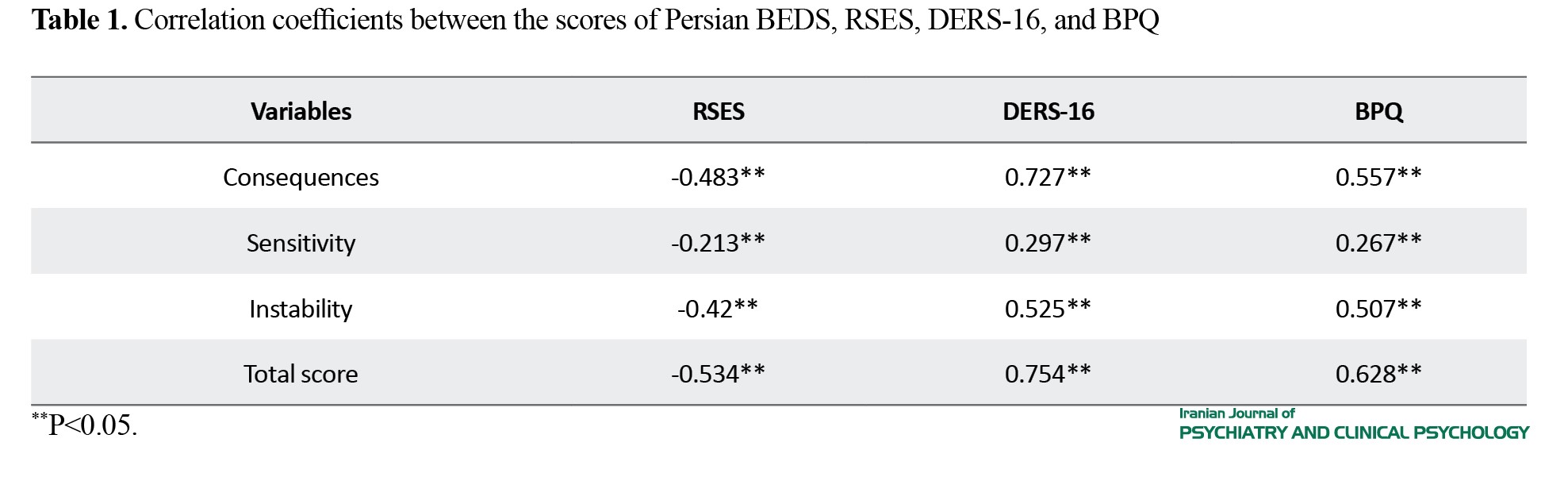
Among 814 participants, 277 were female (34%), 262 male (32.2%) and 275 with unknown gender (33.8%).The participants’ educational backgrounds varied, with the highest percentage holding a bachelor’s degree (34.4%). The mean age of participants was 35.83±12.8 years. To assess construct validity, participants were randomly divided into two groups. The first group underwent exploratory factor analysis, while the second group underwent confirmatory factor analysis. Before performing the factor analyses, the Kaiser-Meyer-Olkin (KMO) measure (0.805) and Bartlett’s test of sphericity (χ2=1095.385, P=0.001) confirmed the suitability of the data for factor analysis. As can be seen in Table 1, the Persian BEDS’s scores in total and in domains (consequences, sensitivity, instability) had significant positive relationships with the DERS-16 and BPQ scores, and a significant negative relationships with the RSES score.
The internal consistency (Cronbach’s α) was 0.75 for the overall scale, 0.77 for the consequences, 0.68 for the sensitivity, and 0.51 for the instability domains.
Conclusion
The results demonstrated satisfactory convergent and divergent validity, and construct validity of the Persian BEDS. In conclusion, the Persian BEDS has strong psychometric properties and is a reliable tool for the use for both research and clinical purposes in Iran.
Ethical Considerations
Compliance with ethical guidelines
This study was approved by the Research Ethics Committee of Kharazmi University, Tehran, Iran (Code: IR.KHU.REC.1402.099). All participants provided written informed consent after receiving complete information about the study objectives and procedures. Their personal information was kept confidential, and they had the right to leave the study at any time.
Funding
This article was extracted from the PhD dissertation master's thesis Fatemeh Ayatmehr, approved by the Department of Clinical Psychology, Faculty of Psychology and Education, Kharazmi University, Tehran, Iran. This research did not receive any specific grant from funding agencies in the public, commercial, or not-for profit sectors.
Authors contributions
Study design, data collection, analysis, and writing the original draft: Fatemeh Ayatmehr; Review and editing: Alireza Moradi, Robabeh Noori Qasemi-Abadi, and Mehdi Akbari; Supervision: Alireza Moradi; Final approval: All authors.
Conflicts of interest
The authors declare no conflict of interest.
Acknowledgments
The authors would like to thank Mavaddat Saeedi, Shiva Jamshidi, and Alireza Jamalu for their assistance in assessing the questionnaire’s translated version.
Emotion regulation involves processes used by individuals to manage, evaluate, and modify their emotional responses. These processes include both cognitive and behavioral strategies. Models such as the cognitive emotion regulation model and the process model of emotion regulation, describe strategies for emotion regulation, categorized into positive and negative strategies. The biopsychosocial model further identifies four components: Emotional sensitivity, emotional instability, emotional reactivity, and consequences of dysregulation. Emotion dysregulation, the inability to adaptively manage emotions, is linked to a variety of psychological disorders. Tools such as the emotion regulation questionnaire (ERQ) assess two primary strategies including cognitive reappraisal and suppression, while the difficulties in emotion regulation scale (DERS) focuses on the behavioral and emotional outcomes of dysregulation. Despite shorter versions such as DERS-SF, these tools fail to fully address all aspects of emotional dysregulation. In this regard, the brief emotion dysregulation scale (BEDS) was developed based on Carpenter and Trull’s multi-component model. Unlike other tools, the BEDS emphasizes the experience and consequences of emotional dysregulation rather than specific strategies. It is particularly relevant for disorders such as borderline personality disorder. This study aimed to examine the psychometric properties of the Persian version of the BEDS for the Iranian population, in order to provide a reliable tool for screening and assessing emotion dysregulation in both clinical and research settings in Iran.
Methods
This is a psychometrics, descriptive/correlational study. Participants were 814 individuals selected via convenience sampling from the general population of Iran. Inclusion criteria were informed consent, literacy, and an age range of 18 to 70 years. The sample size was determined based on Klein’s recommendation, considering 5 participants per parameter. A demographic form collected their information including age, gender, marital status, educational level, psychiatric history, and economic status.
The English version of the questionnaire was first translated into Persian and revised by language experts and psychologists for item quality. After a final revision, the questionnaire was distributed via online platforms (Instagram and Telegram). A total of 900 participants completed the questionnaire. After excluding incomplete responses, 814 valid questionnaires remained for final analysis.
To assess the convergent and divergent validity of the Persian version, we used the borderline personality questionnaire (BPQ), DERS (with 16 items, measuring emotional dysregulation such as lack of emotional clarity, impulsivity, and limited access to effective regulation strategies), and the Rosenberg self-esteem scale (RSES).
Results
Among 814 participants, 277 were female (34%), 262 male (32.2%) and 275 with unknown gender (33.8%).The participants’ educational backgrounds varied, with the highest percentage holding a bachelor’s degree (34.4%). The mean age of participants was 35.83±12.8 years. To assess construct validity, participants were randomly divided into two groups. The first group underwent exploratory factor analysis, while the second group underwent confirmatory factor analysis. Before performing the factor analyses, the Kaiser-Meyer-Olkin (KMO) measure (0.805) and Bartlett’s test of sphericity (χ2=1095.385, P=0.001) confirmed the suitability of the data for factor analysis. As can be seen in Table 1, the Persian BEDS’s scores in total and in domains (consequences, sensitivity, instability) had significant positive relationships with the DERS-16 and BPQ scores, and a significant negative relationships with the RSES score.
The internal consistency (Cronbach’s α) was 0.75 for the overall scale, 0.77 for the consequences, 0.68 for the sensitivity, and 0.51 for the instability domains.
Conclusion
The results demonstrated satisfactory convergent and divergent validity, and construct validity of the Persian BEDS. In conclusion, the Persian BEDS has strong psychometric properties and is a reliable tool for the use for both research and clinical purposes in Iran.
Ethical Considerations
Compliance with ethical guidelines
This study was approved by the Research Ethics Committee of Kharazmi University, Tehran, Iran (Code: IR.KHU.REC.1402.099). All participants provided written informed consent after receiving complete information about the study objectives and procedures. Their personal information was kept confidential, and they had the right to leave the study at any time.
Funding
This article was extracted from the PhD dissertation master's thesis Fatemeh Ayatmehr, approved by the Department of Clinical Psychology, Faculty of Psychology and Education, Kharazmi University, Tehran, Iran. This research did not receive any specific grant from funding agencies in the public, commercial, or not-for profit sectors.
Authors contributions
Study design, data collection, analysis, and writing the original draft: Fatemeh Ayatmehr; Review and editing: Alireza Moradi, Robabeh Noori Qasemi-Abadi, and Mehdi Akbari; Supervision: Alireza Moradi; Final approval: All authors.
Conflicts of interest
The authors declare no conflict of interest.
Acknowledgments
The authors would like to thank Mavaddat Saeedi, Shiva Jamshidi, and Alireza Jamalu for their assistance in assessing the questionnaire’s translated version.
References
- Gross JJ. The emerging field of emotion regulation: An integrative review. Review of General Psychology. 1998; 2(3):271-99. [DOI:10.1037//1089-2680.2.3.271]
- Gross JJ. The process model of emotion regulation. Journal of Personality and Social Psychology. 2007; 93(2):349-71.
- Garnefski N, Kraaij V. The cognitive emotion regulation questionnaire. European Journal of Psychological Assessment. 2007; 23(3):141-9. [DOI:10.1027/1015-5759.23.3.141]
- Garnefski N, Kraaij V, Spinhoven P. Negative life events, cognitive emotion regulation and depression. Journal of Abnormal Psychology. 2001; 110(4):107-16. [DOI:10.1037/t03801-000]
- Carpenter RW, Trull TJ. Components of emotion dysregulation in borderline personality disorder: A review. Current Psychiatry Reports. 2013; 15:1-8. [DOI:10.1007/s11920-012-0335-2] [PMID]
- Linehan MM. Cognitive-behavioral treatment of borderline personality disorder. New York: Guilford Press; 1993. [Link]
- Crowell SE, Beauchaine TP, Linehan MM. A biosocial developmental model of borderline personality: Elaborating and extending Linehan’s theory. Psychology Bulletin. 2009; 135:495-510. [DOI:10.1037/a0015616] [PMID]
- Lincoln TM, Schulze L, Renneberg B. The role of emotion regulation in the characterization, development and treatment of psychopathology. Nature Reviews Psychology. 2022; 1(5):272-86. [DOI:10.1038/s44159-022-00040-4]
- Freitag GF, Grassie HL, Jeong A, Mallidi A, Comer JS, Ehrenreich-May J, Brotman MA. Systematic review: Questionnaire-based measurement of emotion dysregulation in children and adolescents. Journal of the American Academy of Child and Adolescent Psychiatry. 2023; 62(7):728-63. [DOI:10.1016/j.jaac.2022.07.866] [PMID]
- Cludius B, Mennin D, Ehring T. Emotion regulation as a transdiagnostic process. Emotion. 2020; 20(1):37. [DOI:10.1037/emo0000646] [PMID]
- Miola A, Cattarinussi G, Antiga G, Caiolo S, Solmi M, Sambataro F. Difficulties in emotion regulation in bipolar disorder: A systematic review and meta-analysis. Journal of Affective Disorders. 2022; 302:352-60. [DOI:10.1016/j.jad.2022.01.102] [PMID]
- Ruan QN, Chen YH, Yan WJ. A network analysis of difficulties in emotion regulation, anxiety, and depression for adolescents in clinical settings. Child and Adolescent Psychiatry and Mental Health. 2023; 17(1):29. [DOI:10.1186/s13034-023-00574-2] [PMID]
- Nazari F, Gharraee B, Zahedi Tajrishi K. [Mediating role of emotion dysregulation, experiential avoidance, and rumination in the relationship of emotional schemas with obsessive-compulsive disorder symptoms (Persian)]. Iranian Journal of Psychiatry and Clinical Psychology. 2023; 28(4):478-91. [DOI:10.32598/ijpcp.28.4.4377.1]
- Golombek K, Lidle L, Tuschen-Caffier B, Schmitz J, Vierrath V. The role of emotion regulation in socially anxious children and adolescents: A systematic review. European Child & Adolescent Psychiatry. 2020; 29(11):1479-501. [DOI:10.1007/s00787-019-01359-9] [PMID]
- Schnabel K, Petzke TM, Witthöft M. The emotion regulation process in somatic symptom disorders and related conditions-A systematic narrative review. Clinical Psychology Review. 2022; 97:102196. [DOI:10.1016/j.cpr.2022.102196] [PMID]
- Conroy K, Curtiss JE, Barthel AL, Lubin R, Wieman S, Bui E, et al. Emotion regulation flexibility in generalized anxiety disorder. Journal of Psychopathology and Behavioral Assessment. 2020; 42:93-100. [DOI:10.1007/s10862-019-09773-8] [PMID]
- Musser ED, Nigg JT. Emotion dysregulation across emotion systems in attention deficit/hyperactivity disorder. Journal of Clinical Child and Adolescent Psychology. 2019; 48(1):153-65. [DOI:10.1080/15374416.2016.1270828] [PMID]
- Soler-Gutiérrez AM, Pérez-González JC, Mayas J. Evidence of emotion dysregulation as a core symptom of adult ADHD: A systematic review. Plos One. 2023; 18(1):e0280131. [DOI:10.1371/journal.pone.0280131] [PMID]
- Stellern J, Xiao KB, Grennell E, Sanches M, Gowin JL, Sloan ME. Emotion regulation in substance use disorders: A systematic review and meta-analysis. Addiction. 2023; 118(1):30-47. [DOI:10.1111/add.16001] [PMID]
- Riddle DR, Presseller EK, Manasse SM, Juarascio AS. Latent profiles of emotion dysregulation among individuals with binge-spectrum eating disorders: Associations with eating disorder pathology. European Eating Disorders Review. 2023; 31(6):793-801. [DOI:10.1002/erv.3009] [PMID]
- Leppanen J, Brown D, McLinden H, Williams S, Tchanturia K. The role of emotion regulation in eating disorders: A network meta-analysis approach. Frontiers in Psychiatry. 2022; 13:793094. [DOI:10.3389/fpsyt.2022.793094] [PMID]
- Gross JJ, John OP. Individual differences in two emotion regulation processes: Implications for affect, relationships, and well-being. Journal of Personality and Social Psychology. 2003; 85(2):348-62. [DOI:10.1037/0022-3514.85.2.348] [PMID]
- Gratz KL, Roemer L. Multidimensional assessment of emotion regulation and dysregulation: Development, factor structure, and initial validation of the difficulties in emotion regulation scale. Journal of Psychopathology and Behavioral Assessment. 2004; 26(1):41-54. [DOI:10.1023/B:JOBA.0000007455.08539.94]
- Bjureberg J, Ljótsson B, Tull MT, Hedman E, Sahlin H, Lundh LG, et al. Development and validation of a brief version of the Difficulties in Emotion Regulation Scale: The DERS-16. Journal of Psychopathology and Behavioral Assessment. 2016; 38:284-96. [DOI:10.1007/s10862-015-9514-x] [PMID]
- Victor SE, Klonsky ED. Validation of a brief version of the difficulties in emotion regulation scale (DERS-18) in five samples. Journal of Psychopathology and Behavioral Assessment. 2016; 38:582-9. [DOI:10.1007/s10862-016-9547-9]
- Kaufman EA, Xia M, Fosco G, Yaptangco M, Skidmore CR, Crowell SE. The difficulties in emotion regulation scale short form (DERS-SF): Validation and replication in adolescent and adult samples. Journal of Psychopathology and Behavioral Assessment. 2016; 38:443-55. [DOI:10.1007/s10862-015-9529-3]
- Skutch JM, Wang SB, Buqo T, Haynos AF, Papa A. Which brief is best? Clarifying the use of three brief versions of the difficulties in emotion regulation scale. Journal of Psychopathology and Behavioral Assessment. 2019; 41:485-94. [DOI:10.1007/s10862-019-09736-z] [PMID]
- Wycoff AM, Griffin SA, Helle AC, Haney AM, Watts AL, Trull TJ. The brief emotion dysregulation scale: Development, preliminary validation, and recommendations for use. Assess. 2024; 31(2):335-49. [DOI:10.1177/10731911231161800] [PMID]
- Kline RB. Principles and practice of structural equation modeling. 3rd ed. New York: Guilford Press; 2015. [Link]
- World Health Organization. WHO package of interventions on mental health, substance use and disability: Mental health, neurological and substance use conditions. Version 1.0. Geneva: WHO; 2023.
- Leichsenring F. Development and first results of the Borderline Personality Inventory: A self-report instrument for assessing borderline personality organization. Journal of Personality Assessment. 1999; 73(1):45-63. [DOI:10.1207/S15327752JPA730104] [PMID]
- Mohammadzadeh A, Rezaee A. [Validation of borderline personality inventory in Iranian population (Persian)]. Journal of Behavioural Science. 2011; 5(3):23-34. [Link]
- Fallahi V, Narimani M, Atadokht A. [Psychometric properties of the difficulties in emotion regulation scale brief form (DERS-16): In a group of Iranian adolescents (Persian)]. Journal of Shahid Sadoughi University of Medical Sciences. 2021; 29(5):3721-35. [DOI:10.18502/ssu.v29i5.6772]
- Rosenberg M. Rosenberg Self-Esteem Scale (RSE). In: Acceptance and commitment therapy: Measures package. 1965; 61:52. [Link]
- Rajabi GR, Beholah N. [Reliability and validity of the rosenberg self-esteem scale in first-year students of Shahid Chamran University (Persian)]. Journal of Educational Psychology. 2007; 3(2):33-48. [Link]
- Carlson EA, Egeland B, Sroufe LA. A prospective investigation of the development of borderline personality symptoms. Development and Psychopathology. 2009; 21:1311-34. [DOI:10.1017/S0954579409990174] [PMID]
- Seitz KI, Leitenstorfer J, Krauch M, Hillmann K, Boll S, Ueltzhoeffer K, et al. An eye-tracking study of interpersonal threat sensitivity and adverse childhood experiences in borderline personality disorder. Borderline Personality Disorder and Emotion Dysregulation. 2021; 8:1-2. [DOI:10.1186/s40479-020-00141-7] [PMID]
- D’Aurizio G, Di Stefano R, Socci V, Rossi A, Barlattani T, Pacitti F, et al. The role of emotional instability in borderline personality disorder: A systematic review. Annals of General Psychiatry. 2023; 22(1):9. [DOI:10.1186/s12991-023-00439-0] [PMID]
- Grecucci A, Lapomarda G, Messina I, Monachesi B, Sorella S, Siugzdaite R. Structural features related to affective instability correctly classify patients with borderline personality disorder. A supervised machine learning approach. Frontiers in Psychiatry. 2022; 13:804440. [DOI:10.3389/fpsyt.2022.804440] [PMID]
- Buchman-Wildbaum T, Unoka Z, Dudas R, Vizin G, Demetrovics Z, Richman MJ. Shame in borderline personality disorder: A meta-analysis. Journal of Personality Disorders. 2021; 35(Suppl A):149-61. [DOI:10.1521/pedi_2021_35_515] [PMID]
- McCloskey KD, Cox DW, Ogrodniczuk JS, Laverdière O, Joyce AS, Kealy D. Interpersonal problems and social dysfunction: Examining patients with avoidant and borderline personality disorder symptoms. Journal of Clinical Psychology. 2021; 77(1):329-39. [DOI:10.1002/jclp.23033] [PMID]
- Euler S, Nolte T, Constantinou M, Griem J, Montague PR, Fonagy P, et al. Interpersonal problems in borderline personality disorder: Associations with mentalizing, emotion regulation, and impulsiveness. Journal of Personality Disorders. 2021; 35(2):177-93. [DOI:10.1521/pedi_2019_33_427] [PMID]
- Haliczer LA, Woods SE, Dixon-Gordon KL. Emotion regulation difficulties and interpersonal conflict in borderline personality disorder. Personality Disorders: Theory, Research, and Treatment. 2021; 12(4):347. [DOI:10.1037/per0000436] [PMID]
- Antunes AV, Santos C, Oliveira P, Almeida TC. Do difficulties in emotion regulation impact self-esteem and adult attachment?-the role of trauma. Annals of Medicine. 2021; 53(sup1):S159-60. [DOI:10.1080/07853890.2021.1896150]
Type of Study: Original Research |
Subject:
Psychiatry and Psychology
Received: 2025/06/1 | Accepted: 2025/08/1 | Published: 2025/08/1
Received: 2025/06/1 | Accepted: 2025/08/1 | Published: 2025/08/1
| Rights and permissions | |
 |
This work is licensed under a Creative Commons Attribution-NonCommercial 4.0 International License. |

Copyright © The Author(s);
This is an open access article distributed under the terms of the Creative Commons Attribution License (CC-By-NC), which permits use, distribution, and reproduction in any medium, provided the original work is properly cited and is not used for commercial purposes.
Contact Information