Wed, Aug 19, 2026
| فارسی
Volume 31, Issue 1 (Continuously Updated 2025)
IJPCP 2025, 31(1): 0-0 |
Back to browse issues page



Download citation:
BibTeX | RIS | EndNote | Medlars | ProCite | Reference Manager | RefWorks
Send citation to:


BibTeX | RIS | EndNote | Medlars | ProCite | Reference Manager | RefWorks
Send citation to:
Ahmadrad F, Saberi Zafarghandi M B, Azami E, Aqeli M, Deylami Azdi S. A Canonical Correlation Analysis of Virtual Social Media Usage Patterns and Psychosocial Outcomes. IJPCP 2025; 31 (1)
URL: http://ijpcp.iums.ac.ir/article-1-4509-en.html
URL: http://ijpcp.iums.ac.ir/article-1-4509-en.html
Farid Ahmadrad1 

 , Mohammad Bagher Saberi Zafarghandi2 , Erfan Azami3 , Mustafa Aqeli4 , Sahar Deylami Azdi5
, Mohammad Bagher Saberi Zafarghandi2 , Erfan Azami3 , Mustafa Aqeli4 , Sahar Deylami Azdi5
1- Department of Assessment and Measurement, Faculty of Psychology and Education, Allameh Tabatabaei University, Tehran, Iran. , F_ahmadrad@atu.ac.ir
2- Department of Addiction, School of Behavioral Sciences and Mental Health (Tehran Institute of Psychiatry), Iran University of Medical Sciences, Tehran, Iran.
3- Department of Assessment and Measurement, Faculty of Psychology and Education, Allameh Tabatabaei University, Tehran, Iran.
4- Department of International Relations, Faculty of Law and Political Science, Allameh Tabatabaei University, Tehran, Iran.
5- Department of Clinical Psychology, Faculty of Medical Sciences - Dr. Meftah, Islamic Azad University, Tonekabon Branch, Rasht, Iran.
2- Department of Addiction, School of Behavioral Sciences and Mental Health (Tehran Institute of Psychiatry), Iran University of Medical Sciences, Tehran, Iran.
3- Department of Assessment and Measurement, Faculty of Psychology and Education, Allameh Tabatabaei University, Tehran, Iran.
4- Department of International Relations, Faculty of Law and Political Science, Allameh Tabatabaei University, Tehran, Iran.
5- Department of Clinical Psychology, Faculty of Medical Sciences - Dr. Meftah, Islamic Azad University, Tonekabon Branch, Rasht, Iran.
Full-Text [PDF 7033 kb]
(371 Downloads)
| Abstract (HTML) (742 Views)
Full-Text: (255 Views)
Introduction
Human societies, in pursuit of greater control and efficiency, have designed and developed advanced technologies. One of the important technologies is information and communication technology, which has great potential to increase the speed of communication and the flow of information. Virtual social media (VSM) platforms have become an integral part of People’s lives, particularly among younger age groups with high daily usage rates. In this context, social media use serves as a critical factor in either amplifying or mitigating the psychological and behavioral consequences of these platforms. In addition to the usage rate, factors such as manner of use, timing, purpose of engagement, and cognitive-emotional involvement with the content play significant roles in shaping these outcomes. The present study aimed to examine the relationships between patterns of VSM use (e.g., during meals, before bedtime, and after waking up in the morning) and psychosocial outcomes (social, behavioral, emotional, leisure, educational/academic).
Methods
This is a descriptive-correlational study using the canonical correlation analysis. The study population consisted of all residents of Tehran, Iran, during the period of 2020-2021. Inclusion criteria were: residence in Tehran, active use of VSM, willingness to participate in the study, and age ≥18 years. Exclusion criteria were incomplete or invalid responses and the presence of severe mental or cognitive disorders. Sampling was conducted using a multi-stage cluster method. Initially, four districts were randomly selected from among Tehran’s 22 municipal districts. Subsequently, participants meeting the inclusion criteria were recruited using a convenience sampling from the selected districts. Out of 426 completed questionnaires, 13 were excluded due to missing data, and the final analysis was conducted on data from 413 participants. Data collection was conducted using the Social Media Sites Addiction Scale - Iranian version (SMSAS-IR). Data analysis was performed in SPSS software version 27 and R software.
Results
The results of the canonical correlation analysis indicated that among five sets of canonical variables, only the first set yielded a significant correlation coefficient (r= 0.72, P<0.001), explaining 47% of the variance shared by two-variable sets. This value reflects a strong and statistically significant relationship between VSM usage patterns and psychosocial outcomes. As presented in Table 1, among usage patterns, those with the highest canonical loadings included: daily usage (0.85), use before bedtime (0.75), and use immediately after waking up (0.73). The duration of VSM use demonstrated the lowest canonical loading (0.26).
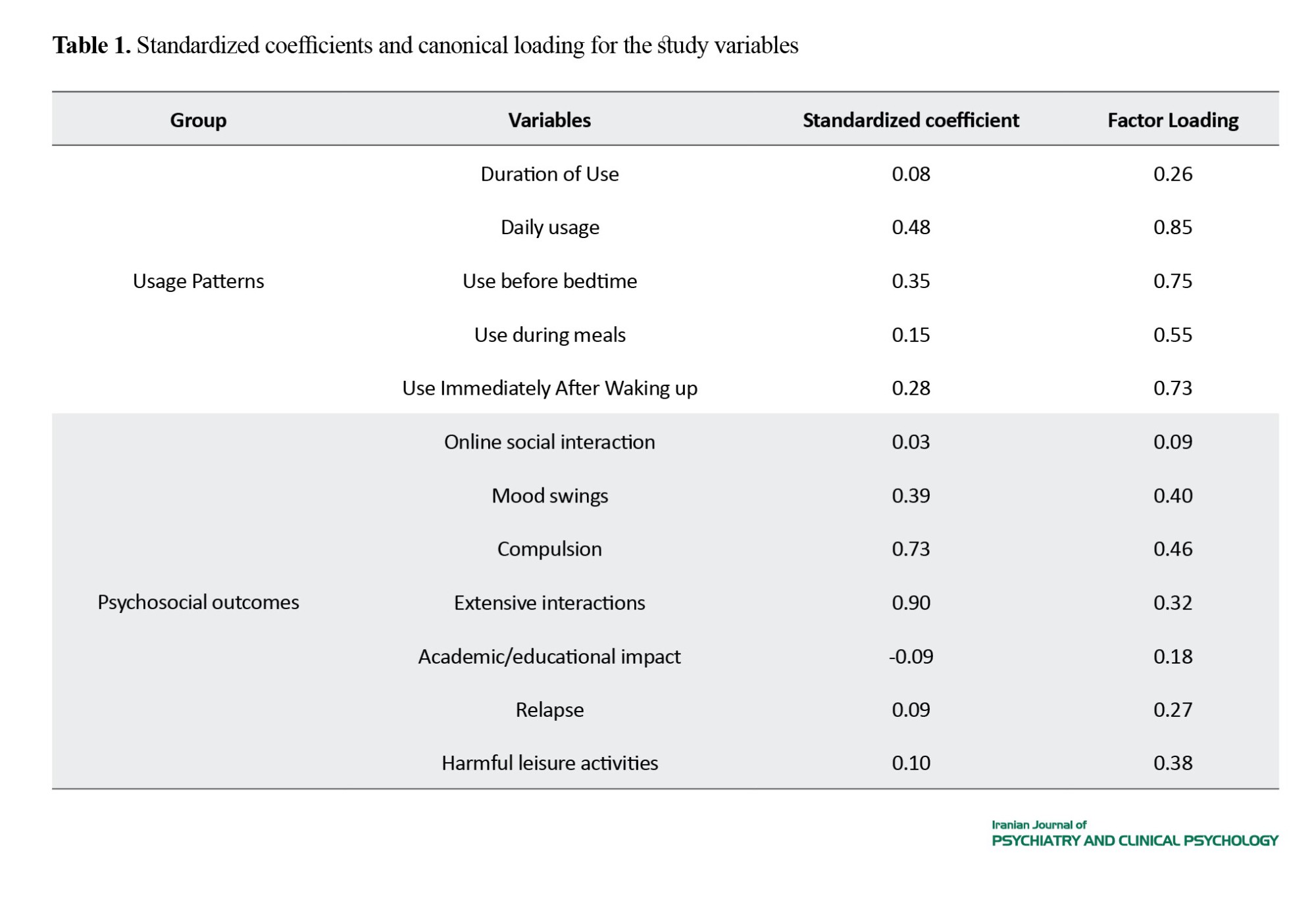
Among the psychosocial outcomes, the variables with the highest canonical loading included compulsion (0.46), mood swings (0.4), harmful leisure activities (0.38), and extensive interactions (0.32). These results indicate that maladaptive use of VSM can lead to mood changes, behavioral addictions, and harmful forms of leisure. In contrast, online social interaction (0.09) and academic/educational performance (0.18) had lower canonical loadings.
Conclusions
The findings of this study indicate that maladaptive use of VSM is significantly associated with psychosocial harms. Daily VSM use, VSM use before bedtime, and VSM use after waking up were more powerful predictors of psychosocial harms. These results suggest that both the percentage and time of VSM use can contribute to psychological and social problems. Compulsive use and mood swings were the key outcomes of maladaptive VSM use. Our findings underscore the importance of time management in using VSM and the enhancement of users’ knowledge of the psychosocial harms associated with maladaptive VSM use. In this regard, development and implementation of educational programs are needed to prevent mood and behavioral disorders among people.
Ethical Considerations
Compliance with ethical guidelines
This study received ethical approval from the Ethics Committee of Iran University of Medical Sciences (Code: IR.IUMS.REC.1398.1317). Informed consent was obtained from all participants before data collection.
Funding
This article is part of a research project, funded by School of Behavioral Sciences and Mental Health, Iran University of Medical Sciences.
Authors contributions
Conceptualization, methodology, validation, formal analysis, investigation, resources, data curation, original draft preparation, review & editing, visualization, supervision, project administration: Farid Ahmadrad; Methodology, validation, investigation, review & editing, supervision: Mohammad Bagher Saberi Zafarghandi; Software, data curation, formal analysis, visualization, review & editing: Erfan Azami; Investigation, resources, data curation; review & editing: Mustafa Aqeli; Investigation, resources, validation, review & editing: Sahar Deylami Azdi;
Conflicts of interest
The authors declare no conflict of interest.
Acknowledgments
The authors would like to thank all participants for their cooperation in this study.
Human societies, in pursuit of greater control and efficiency, have designed and developed advanced technologies. One of the important technologies is information and communication technology, which has great potential to increase the speed of communication and the flow of information. Virtual social media (VSM) platforms have become an integral part of People’s lives, particularly among younger age groups with high daily usage rates. In this context, social media use serves as a critical factor in either amplifying or mitigating the psychological and behavioral consequences of these platforms. In addition to the usage rate, factors such as manner of use, timing, purpose of engagement, and cognitive-emotional involvement with the content play significant roles in shaping these outcomes. The present study aimed to examine the relationships between patterns of VSM use (e.g., during meals, before bedtime, and after waking up in the morning) and psychosocial outcomes (social, behavioral, emotional, leisure, educational/academic).
Methods
This is a descriptive-correlational study using the canonical correlation analysis. The study population consisted of all residents of Tehran, Iran, during the period of 2020-2021. Inclusion criteria were: residence in Tehran, active use of VSM, willingness to participate in the study, and age ≥18 years. Exclusion criteria were incomplete or invalid responses and the presence of severe mental or cognitive disorders. Sampling was conducted using a multi-stage cluster method. Initially, four districts were randomly selected from among Tehran’s 22 municipal districts. Subsequently, participants meeting the inclusion criteria were recruited using a convenience sampling from the selected districts. Out of 426 completed questionnaires, 13 were excluded due to missing data, and the final analysis was conducted on data from 413 participants. Data collection was conducted using the Social Media Sites Addiction Scale - Iranian version (SMSAS-IR). Data analysis was performed in SPSS software version 27 and R software.
Results
The results of the canonical correlation analysis indicated that among five sets of canonical variables, only the first set yielded a significant correlation coefficient (r= 0.72, P<0.001), explaining 47% of the variance shared by two-variable sets. This value reflects a strong and statistically significant relationship between VSM usage patterns and psychosocial outcomes. As presented in Table 1, among usage patterns, those with the highest canonical loadings included: daily usage (0.85), use before bedtime (0.75), and use immediately after waking up (0.73). The duration of VSM use demonstrated the lowest canonical loading (0.26).
Among the psychosocial outcomes, the variables with the highest canonical loading included compulsion (0.46), mood swings (0.4), harmful leisure activities (0.38), and extensive interactions (0.32). These results indicate that maladaptive use of VSM can lead to mood changes, behavioral addictions, and harmful forms of leisure. In contrast, online social interaction (0.09) and academic/educational performance (0.18) had lower canonical loadings.
Conclusions
The findings of this study indicate that maladaptive use of VSM is significantly associated with psychosocial harms. Daily VSM use, VSM use before bedtime, and VSM use after waking up were more powerful predictors of psychosocial harms. These results suggest that both the percentage and time of VSM use can contribute to psychological and social problems. Compulsive use and mood swings were the key outcomes of maladaptive VSM use. Our findings underscore the importance of time management in using VSM and the enhancement of users’ knowledge of the psychosocial harms associated with maladaptive VSM use. In this regard, development and implementation of educational programs are needed to prevent mood and behavioral disorders among people.
Ethical Considerations
Compliance with ethical guidelines
This study received ethical approval from the Ethics Committee of Iran University of Medical Sciences (Code: IR.IUMS.REC.1398.1317). Informed consent was obtained from all participants before data collection.
Funding
This article is part of a research project, funded by School of Behavioral Sciences and Mental Health, Iran University of Medical Sciences.
Authors contributions
Conceptualization, methodology, validation, formal analysis, investigation, resources, data curation, original draft preparation, review & editing, visualization, supervision, project administration: Farid Ahmadrad; Methodology, validation, investigation, review & editing, supervision: Mohammad Bagher Saberi Zafarghandi; Software, data curation, formal analysis, visualization, review & editing: Erfan Azami; Investigation, resources, data curation; review & editing: Mustafa Aqeli; Investigation, resources, validation, review & editing: Sahar Deylami Azdi;
Conflicts of interest
The authors declare no conflict of interest.
Acknowledgments
The authors would like to thank all participants for their cooperation in this study.
References
- Ahn J. The effect of social network sites on adolescents’ social and academic development: Current theories and controversies. Journal of the American Society for information Science and Technology. 2011; 62(8):1435-45. [DOI:10.1002/asi.21540]
- Ali V, Muntean CH, Yaqoob A. Exploring the impact of social media on mental health and well-being: A multi-dimensional analysis. In: Hodson DD, Grimaila MR, Arabnia HR, Deligiannidis L, Wagner TJ, editors. Scientific Computing and Bioinformatics and Computational Biology. Las Vegas: 22nd International Conference, CSC; 2024 [DOI:10.1007/978-3-031-85902-1_16]
- Ellison NB, Boyd D. Sociality through social network sites. In: Dutton WH, editor. The Oxford handbook of internet studies. Oxford: Oxford Academic; 2013. [DOI:10.1093/oxfordhb/9780199589074.013.0008]
- Jadidi M, Ahmadrad F, Sarkeshikian SS, Seyed Moradpoor M. Validation of gambling related cognitions scale-Iranian version (GRCS-IR). Addiction & Health. 2023; 15(4):275-80. [DOI:10.34172/ahj.2023.1431] [PMID]
- Pelling EL, White KM. The theory of planned behavior applied to young people’s use of social networking web sites. Cyberpsychology & Behavior. 2009; 12(6):755-9. [DOI:10.1089/cpb.2009.0109] [PMID]
- Kietzmann JH, Hermkens K, McCarthy IP, Silvestre BS. Social media? Get serious! Understanding the functional building blocks of social media. Business Horizons. 2011; 54(3):241-51. [DOI:10.1016/j.bushor.2011.01.005]
- Massari L. Analysis of myspace user profiles. Information Systems Frontiers. 2010; 12(4):361-7. [DOI:10.1007/s10796-009-9206-8]
- Castells, Manuel. End of millennium: The information age: Economy, society and culture vol. III. Oxford: Blackwell Oxford; 1998. [Link]
- Masrom MB, Busalim AH, Abuhassna H, Mahmood NHN. Understanding students’ behavior in online social networks: a systematic literature review. International Journal of Educational Technology in Higher Education. 2021; 18(1):6. [DOI:10.1186/s41239-021-00240-7]
- Zhao J, Jia T, Wang X, Xiao Y, Wu X. Risk factors associated with social media addiction: An exploratory study. Frontiers in Psychology. 2022; 13:837766. [DOI:10.3389/fpsyg.2022.837766] [PMID]
- Laura B. Developmental psychology from infertility to childhood [Y. Seyed Mohammadi Persian trans]. Tehran: Arasbaran; 2007. [Link]
- Jenkins H, Purushotma R, Weigel M, Clinton K, Robison AJ. Confronting the challenges of participatory culture: Media education for the 21st century. Cambridge: The MIT Press; 2009. [DOI:10.7551/mitpress/8435.001.0001]
- Underwood M, Gruninger M, Obrst L, Baclawski K, Bennett M, Berg-Cross G, et al. Internet of things: Toward smart networked systems and societies: The ontology summit 2015. Applied Ontology. 2015; 10(3-4):355-65. [DOI:10.3233/AO-150153]
- Castells M. Communication power. Paris: OpenEdition; 2013. [DOI:10.4000/books.editionsmsh.10551]
- Aljomaa SS, Qudah MFA, Albursan IS, Bakhiet SF, Abduljabbar AS. Smartphone addiction among university students in the light of some variables. Computers in Human Behavior. 2016; 61:155-64. [DOI:10.1016/j.chb.2016.03.041]
- Chun-Hui W, Yan YH, Shu KM. Projecting the mental model of social networking site usage. Advances in Technology Innovation. 2018; 3(1):36. [Link]
- Ahmadrad F, Jadidi M, Saberizafarghandi MB, Sarkeshikian SS. [The role of virtual social networks in the relationships of couples referring to the family court (Persian)]. New Media Studies. 2023; 9(35):475-510. [DOI:10.22054/nms.2023.68821.1419]
- Du M, Zhao C, Hu H, Ding N, He J, Tian W, et al. Association between problematic social networking use and anxiety symptoms: A systematic review and meta-analysis. BMC Psychology. 2024; 12(1):263. [DOI:10.1186/s40359-024-01705-w] [PMID]
- Rijal A, Thapa P, Sapkota A, Rijal S. Social media use and its impact on mental health among adolescents: A cross sectional study of Kathmandu. Modern Issues of Medicine and Management. 2024; 28(2):1-15. [DOI:10.56580/GEOMEDI50]
- Saberi Zafarghandi MB, Ahmadrad F, Jadidi M, Sarkeshikian SA, Karimkhani F. Development and validation of the Social Media Sites Addiction Scale in Iran (SMSAS-IR). Quarterly of Educational Measurement. 2023; 14(51):164-84. [DOI:10.22054/jem.2023.67445.3365]
- Griffiths MD. Social networking addiction: Emerging themes and issues. Journal of Addiction Research & Therapy. 2013; 4(5):1000e118. [DOI:10.4172/2155-6105.1000e118]
- Savari, K. [The relationship between mental health and family relationships with cell phone addiction (Persian)]. Social Psychology Research. 2013; 3(10):1-14. [Link]
- Roberts JA, David ME. My life has become a major distraction from my cell phone: Partner phubbing and relationship satisfaction among romantic partners. Computers in Human Behavior. 2016; 54:134-41. [DOI:10.1016/j.chb.2015.07.058]
- Fox J, Osborn JL, Warber KM. Relational dialectics and social networking sites: The role of Facebook in romantic relationship escalation, maintenance, conflict, and dissolution. Computers in Human Behavior. 2014; 35:527-34. [DOI:10.1016/j.chb.2014.02.031]
- Ridgway JL, Clayton RB. Instagram unfiltered: Exploring associations of body image satisfaction, Instagram# selfie posting, and negative romantic relationship outcomes. Cyberpsychology, Behavior, and Social Networking. 2016; 19(1):2-7. [DOI:10.1089/cyber.2015.0433] [PMID]
- Valenzuela S, Halpern D, Katz JE. Social network sites, marriage well-being and divorce: Survey and state-level evidence from the United States. Computers in Human Behavior. 2014; 36:94-101. [DOI:10.1016/j.chb.2014.03.034]
- Gong J, Li Y, Niu B, Liu X, Wang Y, Zhou B, et al. The relationship between openness and social anxiety: the chain mediating roles of social networking site use and self-evaluation. BMC Psychology. 2023; 11(1):391. [DOI:10.1186/s40359-023-01412-y] [PMID]
- Das-Friebel A, Lenneis A, Realo A, Sanborn A, Tang NK, Wolke D, et al. Bedtime social media use, sleep, and affective wellbeing in young adults: An experience sampling study. Journal of Child Psychology and Psychiatry. 2020; 61(10):1138-49. [DOI:10.1111/jcpp.13326] [PMID]
- Levenson JC, Shensa A, Sidani JE, Colditz JB, Primack BA. The association between social media use and sleep disturbance among young adults. Preventive Medicine. 2016; 85:36-41. [DOI:10.1016/j.ypmed.2016.01.001] [PMID]
- Levenson JC, Shensa A, Sidani JE, Colditz JB, Primack BA. Social media use before bed and sleep disturbance among young adults in the United States: A nationally representative study. Sleep. 2017; 40(9):zsx113. [DOI:10.1093/sleep/zsx113] [PMID]
- Louzada MLdC, Martins APB, Canella DS, Baraldi LG, Levy RB, Claro RM, et al. Impact of ultra-processed foods on micronutrient content in the Brazilian diet. Revista de Saude Publica. 2015; 49. [DOI:10.1590/S0034-8910.2015049006132]
- Fraga RS, Silva SLR, Santos LCd, Titonele LRdO, Carmo AdS. The habit of buying foods announced on television increases ultra-processed products intake among schoolchildren. Cadernos de Saúde Pública. 2020; 36(8):e00091419. [DOI:10.1590/0102-311x00091419] [PMID]
- Nguyen P, Le LK-D, Nguyen D, Gao L, Dunstan DW, Moodie M. The effectiveness of sedentary behaviour interventions on sitting time and screen time in children and adults: An umbrella review of systematic reviews. International Journal of Behavioral Nutrition and Physical Activity. 2020; 17(1):117. [DOI:10.1186/s12966-020-01009-3] [PMID]
- Guimarães JS, Mais LA, M Leite FH, Horta PM, Santana MO, Martins AP, et al. Abusive advertising of food and drink products on Brazilian television. Health Promotion International. 2022; 37(2):daab025. [DOI:10.1093/heapro/daab025] [PMID]
- Kearney J, Fitzgerald R, Burnside G, Higham S, Flannigan N, Halford JC, et al. Television advertisements for high-sugar foods and beverages: Effect on children’s snack food intake. British Journal of Nutrition. 2021; 125(5):591-7. [DOI:10.1017/S0007114520003116] [PMID]
- Cao Y, Dunstan DW, Sethi P, Owen N. The association of TV viewing time with 2-hour plasma glucose is modified by a prudent dietary pattern. Journal of Diabetes. 2021; 13(8):661-71. [DOI:10.1111/1753-0407.13153] [PMID]
- Delfino LD, dos Santos Silva DA, Tebar WR, Zanuto EF, Codogno JS, Fernandes RA, et al. Screen time by different devices in adolescents: Association with physical inactivity domains and eating habits. The Journal of sports medicine and physical fitness. 2017; 58(3):318-25. [DOI:10.23736/S0022-4707.17.06980-8] [PMID]
- Maia EG, Gomes FMD, Alves MH, Huth YR, Claro RM. Hábito de assistir à televisão e sua relação com a alimentação: Resultados do período de 2006 a 2014 em capitais brasileiras. Cadernos de Saúde Pública. 2016; 32(9):e00104515. [DOI:10.1590/0102-311X00104515]
- Pearson N, Biddle SJ. Sedentary behavior and dietary intake in children, adolescents, and adults: A systematic review. American Journal of Preventive Medicine. 2011; 41(2):178-88. [DOI:10.1016/j.amepre.2011.05.002] [PMID]
- StatsCAN. Physical activity and screen time: Pandemic effects, and other key numbers [Internet]. 2023 [Updated 2023 November 17]. Available at: [Link]
- World Health Organization (WHO). Guidance for monitoring healthy diets globally [Internet]. 2024 [Updated 2024 June 21]. Available from: [Link]
- Cardoso PC, Caldeira TCM, Sousa TMd, Claro RM. Changes in screen time in Brazil: A time-series analysis 2016-2021. American Journal of Health Promotion. 2023; 37(5):681-4. [DOI:10.1177/08901171231152147] [PMID]
- Hardoon DR, Szedmak S, Shawe-Taylor J. Canonical correlation analysis: An overview with application to learning methods. Neural Computation. 2004; 16(12):2639-64. [DOI:10.1162/0899766042321814] [PMID]
- Garson G. Canonical correlation [Internet]. 2008 [Updated 4 July 2009]. Available from: [Link]
- Yang X, Liu W, Liu W, Tao D. A survey on canonical correlation analysis. IEEE Transactions on Knowledge and Data Engineering. 2019; 33(6):2349-68. [DOI:10.1109/TKDE.2019.2958342]
- Rupnik J, Shawe-Taylor J. Multi-view canonical correlation analysis. Paper presented at: Conference on data mining and data warehouses (SiKDD 2010). 12 October 2010; Ljubljana, Slovenia. [Link]
- Lubis SIS, Harmawan V, Rambe AN, Hutasuhut NI. The different between male and female in using indirect speech act in having relationship when texting in WhatsApp. English Education. 2024; 12(2):238-49. [DOI:10.24952/ee.v12i2.14182]
- Cajochen C, Frey S, Anders D, Späti J, Bues M, Pross A, et al. Evening exposure to a light-emitting diodes (LED)-backlit computer screen affects circadian physiology and cognitive performance. Journal of Applied Physiology. 2011; 110(5):1432-8. [DOI:10.1152/japplphysiol.00165.2011] [PMID]
- Tavernier R, Willoughby T. Sleep problems: Predictor or outcome of media use among emerging adults at university? Journal of Sleep Research. 2014; 23(4):389-96. [DOI:10.1111/jsr.12132] [PMID]
- Alliu SI. Social media pranks and the risk of mental health and national development. Paper presented at: Nigerian Psychological Association Conference. 2024 August 28; Nasarawa, Nigeria. [Link]
- Meythaler A. Understanding the role of social media content in inducing anxiety: A qualitative study. Paper presented at: Hawaii International Conference on System Sciences. 2025 January 10; Hilton Waikoloa, Hawaii. [DOI:10.24251/HICSS.2025.334]
- Mattson T, Weng Q, Ren J. Unveiling gender dynamics for mental health posts in social media and generative artificial intelligence. Paper presented at: Hawaii International Conference on System Sciences. 2025 January 10; Hilton Waikoloa, Hawaii. [DOI:10.24251/HICSS.2025.784]
- Casilaoı LB, Salapa AC. Dual effects of social media on adolescent mental health: A systematic review on Philippine Context. Cognizance Journal of Multidisciplinary Studies. 2024; 4(12):358-71. [Link]
- Chen X, Wei S. The impact of social media use for communication and social exchange relationship on employee performance. Journal of Knowledge Management. 2020; 24(6):1289-314. [DOI:10.1108/JKM-04-2019-0167]
- Goodman-Deane J, Mieczakowski A, Johnson D, Goldhaber T, Clarkson PJ. The impact of communication technologies on life and relationship satisfaction. Computers in Human Behavior. 2016; 57:219-29. [DOI:10.1016/j.chb.2015.11.053]
Type of Study: Original Research |
Subject:
Psychiatry and Psychology
Received: 2025/05/11 | Accepted: 2025/11/9 | Published: 2025/12/10
Received: 2025/05/11 | Accepted: 2025/11/9 | Published: 2025/12/10
| Rights and permissions | |
 |
This work is licensed under a Creative Commons Attribution-NonCommercial 4.0 International License. |

Copyright © The Author(s);
This is an open access article distributed under the terms of the Creative Commons Attribution License (CC-By-NC), which permits use, distribution, and reproduction in any medium, provided the original work is properly cited and is not used for commercial purposes.
Contact Information