Mon, Aug 17, 2026
| فارسی
Volume 31, Issue 1 (Continuously Updated 2025)
IJPCP 2025, 31(1): 0-0 |
Back to browse issues page




Download citation:
BibTeX | RIS | EndNote | Medlars | ProCite | Reference Manager | RefWorks
Send citation to:


BibTeX | RIS | EndNote | Medlars | ProCite | Reference Manager | RefWorks
Send citation to:
Ebrahimi-Jamarani M, Azadfallah P, Farahani H. Exploring the Lived Experiences of the Caregivers of Patients With Bipolar Disorder in Iran. IJPCP 2025; 31 (1)
URL: http://ijpcp.iums.ac.ir/article-1-4407-en.html
URL: http://ijpcp.iums.ac.ir/article-1-4407-en.html


1- Department of Psychology, Faculty of Humanities, Tarbiat Modares University, Tehran, Iran.
2- Department of Psychology, Faculty of Humanities, Tarbiat Modares University, Tehran, Iran. ,azadfa_p@modares.ac.ir
2- Department of Psychology, Faculty of Humanities, Tarbiat Modares University, Tehran, Iran. ,
Full-Text [PDF 16303 kb]
(193 Downloads)
| Abstract (HTML) (442 Views)
Full-Text: (151 Views)
Introduction
According to the report of the World Health Organization (WHO), one in four families has a member affected by a mental disorder, with family members typically serving as the primary caregivers. Following the process of deinstitutionalization over recent decades, the primary setting for healthcare in many countries has shifted from hospitals to community-based outpatient service centers. The community-based service centers often support family caregivers and have a significant impact on the lives of individuals with mental illness. One mental disorder that presents numerous challenges for caregivers is bipolar disorder (BD), a chronic, cyclical mood disorder that persists throughout a person’s life, and has long-term effects on patients’ lives, especially visible in their social functioning and quality of life (QoL). Relatives and close friends who provide unpaid assistance to patients on a weekly or daily basis are defined as caregivers. Notably, compared to caregivers of the elderly or individuals with cancer, those who care for people suffering from mental disorders face a much broader range of challenges. For example, the early onset of certain mental illnesses can lead to severe impairments in the patient’s functioning, resulting in a high level of dependency on the caregiver and, consequently, increased stress and difficulties experienced by the caregiver.
Given the healthcare system changes over the past two decades and the increasing emphasis on community-based service provision, families now play an even more central role in caring for individuals with BD. Family members and close friends are the primary sources of support for individuals with this condition. They often face unpredictable mood fluctuations, including episodes of depression, mania, and the risk of suicide. Research on caregivers of individuals with BD shows that they experience a wide range of physical health problems, anxiety, and depression. These issues adversely affect their QoL, occupational and social functioning, interpersonal relationships, and even increase their risk of mortality. Ultimately, these factors alter the way caregivers cope with and respond to the challenges posed by the disorder.
Studies have identified multiple factors that influence how family members confront the reality of having a loved one with a chronic mental illness. These include the stigma surrounding mental health services, the nature of the patient’s needs, illness severity, patient’s gender, caregivers’ demographic and personality traits, the nature of the illness itself, and prevailing cultural values. This study aims to explore the lived experiences of caregivers of individuals with BD in Iran, focusing on the outcomes, facilitators, and inhibitors they encounter. Focusing on the caregiving process for those with BD not only highlights the stress, pain, complex challenges, and psychological burdens faced by these families and the need to prioritize caregivers’ mental well-being, but also brings attention to key variables within the family that play a significant role in the patient’s treatment process.
Methods
This is a qualitative study using the grounded theory approach based on Strauss and Corbin’s (2015) analytical framework. Sampling began purposively and continued until reaching theoretical saturation. Data were collected through 18 unstructured interviews with caregivers and 3 semi-structured interviews with experts in the related fields. Simultaneous coding and data analysis were conducted following the theoretical model.
Results
The analysis identified “role entanglement” as the core theme, and eight categories that explained the caregiving process for individuals with BD (Table 1).
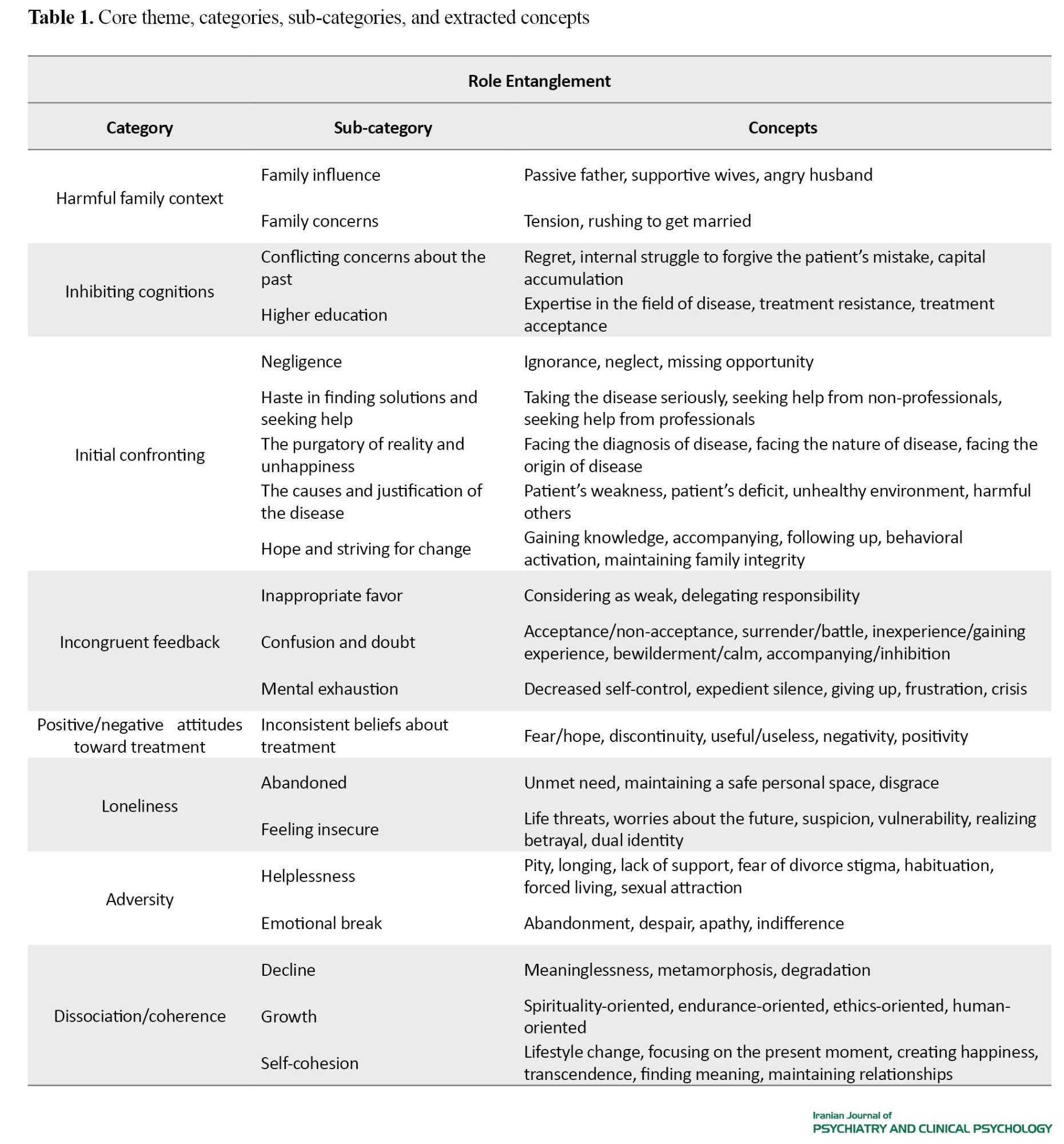
These categories included: Harmful family context, inhibiting cognitions (contextual factors), initial confronting, incongruent feedback, positive/negative attitudes toward treatment (causal factors), loneliness, adversity, dissociation/coherence (consequences).
Conclusion
The findings underscore that caregiving for individuals with BP in Iran is a prolonged and exhausting journey, deeply influenced by personal and cultural variables. Most caregivers struggle to manage the chronic and unpredictable nature of the disorder, which often endangers their mental and physical health. Key challenges included a lack of knowledge about BD among caregivers and significant shortcomings in the diagnosis and treatment of the condition. Addressing these issues is essential to improve the well-being of both caregivers and BD patients. The results of this study indicate that the caregivers’ process of confronting BD begins from the emergence of the first warning signs. However, these signs are often ignored by caregivers for various reasons until a crisis occurs and the situation becomes unmanageable. It is also important to consider that confrontation is a dynamic process shaped by cultural, social, and economic factors and continues in interaction with them. After receiving a diagnosis, the patient’s family members often take on the role of caregiver and face ongoing challenges and confusion as they try to fulfill both their previous and current responsibilities. These challenges are frequently exacerbated by shortcomings in the healthcare system. Since the family function as a dynamic system, maintaining a balance in relationships with the patient and other family members is one of the main challenges caregivers face. This often leads to a constant sense of confusion about the type and extent of appropriate support for the patient, whether to continue the support or let it go, and whether to blame oneself or others. Ultimately, the acceptance of the disorder as a reality in the caregivers’ lives plays a key role. It can either facilitate the process of coping with the various positive and negative consequences they experience or, conversely, lead to serious difficulties.
Ethical Considerations
Compliance with ethical guidelines
This study was approved by the Research Ethics Committee of Tarbiat Modares University, Tehran, Iran (Code: IR.MODARES.REC.1401.032).
Funding
This article was a extracted from PhD dissertation master's thesis of Mohya Ebrahimi Jamarani, Psychology, Faculty of Humanities, Tarbiat Modares University.This research did not receive any specific grant from funding agencies in the public, commercial, or not-for profit sectors
Authors contributions
Design, implementation, data collection and analysis: Mohya Ebrahimi Jamarani; Supervision, review and editing: Parviz Azadfallah; Methodology and supervision: Hojjatollah Farahani.
Conflicts of interest
The authors declared no conflict of interest.
Acknowledgments
The authors would like to thank all participants for their time and cooperation in this study.
According to the report of the World Health Organization (WHO), one in four families has a member affected by a mental disorder, with family members typically serving as the primary caregivers. Following the process of deinstitutionalization over recent decades, the primary setting for healthcare in many countries has shifted from hospitals to community-based outpatient service centers. The community-based service centers often support family caregivers and have a significant impact on the lives of individuals with mental illness. One mental disorder that presents numerous challenges for caregivers is bipolar disorder (BD), a chronic, cyclical mood disorder that persists throughout a person’s life, and has long-term effects on patients’ lives, especially visible in their social functioning and quality of life (QoL). Relatives and close friends who provide unpaid assistance to patients on a weekly or daily basis are defined as caregivers. Notably, compared to caregivers of the elderly or individuals with cancer, those who care for people suffering from mental disorders face a much broader range of challenges. For example, the early onset of certain mental illnesses can lead to severe impairments in the patient’s functioning, resulting in a high level of dependency on the caregiver and, consequently, increased stress and difficulties experienced by the caregiver.
Given the healthcare system changes over the past two decades and the increasing emphasis on community-based service provision, families now play an even more central role in caring for individuals with BD. Family members and close friends are the primary sources of support for individuals with this condition. They often face unpredictable mood fluctuations, including episodes of depression, mania, and the risk of suicide. Research on caregivers of individuals with BD shows that they experience a wide range of physical health problems, anxiety, and depression. These issues adversely affect their QoL, occupational and social functioning, interpersonal relationships, and even increase their risk of mortality. Ultimately, these factors alter the way caregivers cope with and respond to the challenges posed by the disorder.
Studies have identified multiple factors that influence how family members confront the reality of having a loved one with a chronic mental illness. These include the stigma surrounding mental health services, the nature of the patient’s needs, illness severity, patient’s gender, caregivers’ demographic and personality traits, the nature of the illness itself, and prevailing cultural values. This study aims to explore the lived experiences of caregivers of individuals with BD in Iran, focusing on the outcomes, facilitators, and inhibitors they encounter. Focusing on the caregiving process for those with BD not only highlights the stress, pain, complex challenges, and psychological burdens faced by these families and the need to prioritize caregivers’ mental well-being, but also brings attention to key variables within the family that play a significant role in the patient’s treatment process.
Methods
This is a qualitative study using the grounded theory approach based on Strauss and Corbin’s (2015) analytical framework. Sampling began purposively and continued until reaching theoretical saturation. Data were collected through 18 unstructured interviews with caregivers and 3 semi-structured interviews with experts in the related fields. Simultaneous coding and data analysis were conducted following the theoretical model.
Results
The analysis identified “role entanglement” as the core theme, and eight categories that explained the caregiving process for individuals with BD (Table 1).
These categories included: Harmful family context, inhibiting cognitions (contextual factors), initial confronting, incongruent feedback, positive/negative attitudes toward treatment (causal factors), loneliness, adversity, dissociation/coherence (consequences).
Conclusion
The findings underscore that caregiving for individuals with BP in Iran is a prolonged and exhausting journey, deeply influenced by personal and cultural variables. Most caregivers struggle to manage the chronic and unpredictable nature of the disorder, which often endangers their mental and physical health. Key challenges included a lack of knowledge about BD among caregivers and significant shortcomings in the diagnosis and treatment of the condition. Addressing these issues is essential to improve the well-being of both caregivers and BD patients. The results of this study indicate that the caregivers’ process of confronting BD begins from the emergence of the first warning signs. However, these signs are often ignored by caregivers for various reasons until a crisis occurs and the situation becomes unmanageable. It is also important to consider that confrontation is a dynamic process shaped by cultural, social, and economic factors and continues in interaction with them. After receiving a diagnosis, the patient’s family members often take on the role of caregiver and face ongoing challenges and confusion as they try to fulfill both their previous and current responsibilities. These challenges are frequently exacerbated by shortcomings in the healthcare system. Since the family function as a dynamic system, maintaining a balance in relationships with the patient and other family members is one of the main challenges caregivers face. This often leads to a constant sense of confusion about the type and extent of appropriate support for the patient, whether to continue the support or let it go, and whether to blame oneself or others. Ultimately, the acceptance of the disorder as a reality in the caregivers’ lives plays a key role. It can either facilitate the process of coping with the various positive and negative consequences they experience or, conversely, lead to serious difficulties.
Ethical Considerations
Compliance with ethical guidelines
This study was approved by the Research Ethics Committee of Tarbiat Modares University, Tehran, Iran (Code: IR.MODARES.REC.1401.032).
Funding
This article was a extracted from PhD dissertation master's thesis of Mohya Ebrahimi Jamarani, Psychology, Faculty of Humanities, Tarbiat Modares University.This research did not receive any specific grant from funding agencies in the public, commercial, or not-for profit sectors
Authors contributions
Design, implementation, data collection and analysis: Mohya Ebrahimi Jamarani; Supervision, review and editing: Parviz Azadfallah; Methodology and supervision: Hojjatollah Farahani.
Conflicts of interest
The authors declared no conflict of interest.
Acknowledgments
The authors would like to thank all participants for their time and cooperation in this study.
References
- Noorbala AA, Damari B, Riazi IS. [Evaluation of mental disorders incidence trend in Iran (Persian)]. Daneshvar Medicine. 2014; 21(112):1-11. [Link]
- Charara R, Forouzanfar M, Naghavi M, Moradi-Lakeh M, Afshin A, Vos T, et al. The burden of mental disorders in the eastern mediterranean region, 1990-2013. Plos One. 2017; 12(1):e0169575.
- Beer MD. History of psychiatry and the psychiatric profession. Current Opinion in Psychiatry. 2009; 22(6):594-600. [DOI:10.1097/YCO.0b013e328330c3c2] [PMID]
- Avasthi A. Preserve and strengthen family to promote mental health. Indian Journal of Psychiatry. 2010; 52(2):113-26. [DOI:10.4103/0019-5545.64582] [PMID]
- Covinsky KE, Newcomer R, Fox P, Wood J, Sands L, Dane K, et al. Patient and caregiver characteristics associated with depression in caregivers of patients with dementia. Journal of General Internal Medicine. 2003; 18(12):1006-14. [DOI:10.1111/j.1525-1497.2003.30103.x] [PMID]
- Steele A, Maruyama N, Galynker I. Psychiatric symptoms in caregivers of patients with bipolar disorder: A review. Journal of Affective Disorders. 2010; 121(1-2):10-21. [DOI:10.1016/j.jad.2009.04.020] [PMID]
- Fagiolini A, Forgione R, Maccari M, Cuomo A, Morana B, Dell’Osso MC, et al. Prevalence, chronicity, burden and borders of bipolar disorder. Journal of Affective Disorders. 2013; 148(2-3):161-9. [DOI:10.1016/j.jad.2013.02.001] [PMID]
- Shabani A, Teimurinejad S, Kokar S, Ahmadzad Asl M, Shariati B, Mousavi Behbahani Z, et al. Suicide risk factors in Iranian patients with bipolar disorder: A 21- month follow-up from BDPF study. Iranian Journal of Psychiatry and Behavioral Sciences. 2013; 7(1):16-23. [PMID]
- Latifian M, Abdi K, Raheb G, Islam SMS, Alikhani R. Stigma in people living with bipolar disorder and their families: A systematic review. International Journal of Bipolar Disorders. 2023; 11(1):9. [DOI:10.1186/s40345-023-00290-y] [PMID]
- Hsiao C-Y, Van Riper M. Research on caregiving in Chinese families living with mental illness: A critical review. Journal of Family Nursing. 2010; 16(1):68-100. [DOI:10.1177/1074840709358405] [PMID]
- Fan CC, Chen YY. Factors associated with care burden and quality of life among caregivers of the mentally ill in Chinese society. International Journal of Social Psychiatry. 2011; 57(2):195-206. [DOI:10.1177/0020764009348440] [PMID]
- Yu SH, Wang LT, SzuTu WJ, Huang LC, Shen CC, Chen CY. The caregivers’ dilemma: Care burden, rejection, and caregiving behaviors among the caregivers of patients with depressive disorders. Psychiatry Research. 2020; 287:112916. [DOI:10.1016/j.psychres.2020.112916] [PMID]
- Maji KR, Sood M, Sagar R, Khandelwal SK. A follow-up study of family burden in patients with bipolar affective disorder. The International Journal of Social Psychiatry. 2012; 58(2):217-23. [DOI:10.1177/0020764010390442] [PMID]
- Kaushik P, Bhatia M. Burden and quality of life in spouses of patients with schizophrenia and bipolar disorder. 2013. [Link]
- Shirkhoda SA. [The investigation of the amount of cost for bipolar disorder type I and its related factors during the 1-year follow-up for the hospitalized patients in Iran educational-therapeutic psychiatric center [dissertaion]. Tehran: Iran University of Medical Sciences; 2014.
- Sharma N, Chakrabarti S, Grover S. Gender differences in caregiving among family-caregivers of people with mental illnesses. World Journal of Psychiatry. 2016; 6(1):7. [DOI:10.5498/wjp.v6.i1.7] [PMID]
- Alyafei AH, Alqunaibet T, Mansour H, Ali A, Billings J. The experiences of family caregivers of people with severe mental illness in the Middle East: A systematic review and meta-synthesis of qualitative data. Plos One. 2021; 16(7):e0254351. [DOI:10.1371/journal.pone.0254351] [PMID]
- Mianji F, Kirmayer LJ. The globalization of biological psychiatry and the rise of bipolar spectrum disorder in Iran. Culture, Medicine and Psychiatry. 2020; 44(3):404-32. [DOI:10.1007/s11013-019-09665-2] [PMID]
- Kirmayer LJ, Crafa D. What kind of science for psychiatry? Frontier in Human Neuroscience. 2014; 8:435. [DOI:10.3389/fnhum.2014.00435] [PMID]
- Kallivayalil RA. Are we over-dependent on pharmacotherapy? Indian Journal of Psychiatry. 2008; 50(1):7-9. [DOI:10.4103/0019-5545.39750] [PMID]
- Clatworthy J, Bowskill R, Rank T, Parham R, Horne R. Adherence to medication in bipolar disorder: A qualitative study exploring the role of patients’ beliefs about the condition and its treatment. Bipolar Disorders. 2007; 9(6):656-64. [DOI:10.1111/j.1399-5618.2007.00434.x] [PMID]
- Delmas K, Proudfoot J, Parker G, Manicavasagar V. Recoding past experiences: A qualitative study of how patients and family members adjust to the diagnosis of bipolar disorder. The Journal of Nervous and Mental Disease. 2011; 199(2):136-9. [DOI:10.1097/NMD.0b013e3182083175] [PMID]
- Mousavi N, Norozpour M, Taherifar Z, Naserbakht M, Shabani A. Bipolar I disorder: A qualitative study of the viewpoints of the family members of patients on the nature of the disorder and pharmacological treatment non-adherence. BMC Psychiatry. 2021; 21:1-11. [DOI:10.1186/s12888-020-03008-x] [PMID]
- Chakrabarti S. Treatment-adherence in bipolar disorder: A patient-centred approach. World Journal of Psychiatry. 2016; 6(4):399-409. [DOI:10.5498/wjp.v6.i4.399] [PMID]
- Bolhari J, Ramezanzadeh F, Abedinia N, Naghizadeh M, Pahlavani H, Saberi S. To explore identifying the influencing factors of divorce in Tehran. Iranian Journal of Epidemiology. 2012; 8(1):83-93. [Link]
- Afshar H, Masaeli N, Barekatin M, Kiani F. [The relative frequency and socio-demographic correlates of bipolar spectrum disorders in divorced volunteers (Persian)]. Journal of Research in Behavioural Sciences. 2008; 6(1):45-50. [Link]
- Shiraishi N, Reilly J. Positive and negative impacts of schizophrenia on family caregivers: A systematic review and qualitative meta-summary. Social Psychiatry and Psychiatric Epidemiology. 2019; 54(3):277-90. [DOI:10.1007/s00127-018-1617-8] [PMID]
- Corbin J, Strauss A. Basics of qualitative research: Techniques and procedures for developing grounded theory. Champion: Sage Publications; 2014. [Link]
- DeJonckheere M, Vaughn LM. Semistructured interviewing in primary care research: A balance of relationship and rigour. Journal of Family Medicine & Community Health. 2019; 7(2):e000057. [DOI:10.1136/fmch-2018-000057] [PMID]
- O’Connor C, Joffe H. Intercoder reliability in qualitative research: Debates and practical guidelines. International Journal of Qualitative Methods. 2020; 19:1609406919899220. [DOI:10.1177/1609406919899220]
- Johansson V, Kuja-Halkola R, Cannon TD, Hultman CM, Hedman AM. A population-based heritability estimate of bipolar disorder - In a Swedish twin sample. Psychiatry Research. 2019; 278:180-7. [DOI:10.1016/j.psychres.2019.06.010] [PMID]
- Speirs B, Hanstock TL, Kay-Lambkin FJ. The lived experience of caring for someone with bipolar disorder: A qualitative study. Plos One. 2023; 18(1):e0280059. [DOI:10.1371/journal.pone.0280059] [PMID]
- Kumar KS, Vankar GK, Goyal AD, Sharma AS. Stigma and discrimination in patients with schizophrenia and bipolar mood disorder. Annals of Indian Psychiatry. 2020; 4(1):33-9. [DOI:10.4103/aip.aip_49_19]
- Vargas-Huicochea I, Berenzon S, Rascón ML, Ramos L. A bittersweet relationship: What does it mean to be the caregiver of a patient with bipolar disorder? The International Journal of Social Psychiatry. 2018; 64(3):207-16. [DOI:10.1177/0020764018758124] [PMID]
- Azorin JM, Lefrere A, Belzeaux R. The impact of bipolar disorder on couple functioning: implications for care and treatment. A systematic review. Medicina. 2021; 57(8). [DOI:10.3390/medicina57080771] [PMID]
- Pompili M, Harnic D, Gonda X, Forte A, Dominici G, Innamorati M, et al. Impact of living with bipolar patients: Making sense of caregivers’ burden. World Journal of Psychiatry. 2014; 4(1):1-12. [DOI:10.5498/wjp.v4.i1.1] [PMID]
- Granek L, Danan D, Bersudsky Y, Osher Y. Living with bipolar disorder: the impact on patients, spouses, and their marital relationship. Bipolar Disorders. 2016; 18(2):192-9. [DOI:10.1111/bdi.12370] [PMID]
- Dols A, Thesing C, Wouters M, Theunissen J, Sonnenberg C, Comijs H, et al. Burden on caregivers of older patients with bipolar disorder. Aging & Mental Health. 2018; 22(5):686-91. [DOI:10.1080/13607863.2017.1297360] [PMID]
- Barron E, Sharma A, Le Couteur J, Rushton S, Close A, Kelly T, et al. Family environment of bipolar families: A UK study. Journal of Affective Disorders. 2014; 152-154:522-5. [DOI:10.1016/j.jad.2013.08.016] [PMID]
- Stapp EK, Mendelson T, Merikangas KR, Wilcox HC. Parental bipolar disorder, family environment, and offspring psychiatric disorders: A systematic review. Journal of Affective Disorders. 2020; 268:69-81. [DOI:10.1016/j.jad.2020.03.005] [PMID]
- Ferreira GS, Moreira CR, Kleinman A, Nader EC, Gomes BC, Teixeira AM, et al. Dysfunctional family environment in affected versus unaffected offspring of parents with bipolar disorder. The Australian and New Zealand Journal of Psychiatry. 2013; 47(11):1051-7. [DOI:10.1177/0004867413506754] [PMID]
- Romero S, Delbello MP, Soutullo CA, Stanford K, Strakowski SM. Family environment in families with versus families without parental bipolar disorder: A preliminary comparison study. Bipolar Disorders. 2005; 7(6):617-22. [DOI:10.1111/j.1399-5618.2005.00270.x] [PMID]
- Cerimele JM, Fortney JC, Pyne JM, Curran GM. Bipolar disorder in primary care: A qualitative study of clinician and patient experiences with diagnosis and treatment. Family Practice. 2019; 36(1):32-7. [DOI:10.1093/fampra/cmy019] [PMID]
- Buoli M, Cesana BM, Fagiolini A, Albert U, Maina G, de Bartolomeis A, et al. Which factors delay treatment in bipolar disorder? A nationwide study focussed on duration of untreated illness. Early Intervention in Psychiatry. 2021; 15(5):1136-45. [DOI:10.1111/eip.13051] [PMID]
- Miklowitz DJ. The role of the family in the course and treatment of bipolar disorder. Current Directions in Psychological Science. 2007; 16(4):192-6. [DOI:10.1111/j.1467-8721.2007.00502.x] [PMID]
- Fiorillo A, Del Vecchio V, Luciano M, Sampogna G, De Rosa C, Malangone C, et al. Efficacy of psychoeducational family intervention for bipolar I disorder: A controlled, multicentric, real-world study. Journal of Affective Disorders. 2015; 172:291-9. [DOI:10.1016/j.jad.2014.10.021] [PMID]
- Reinares M, Bonnín CM, Hidalgo-Mazzei D, Sánchez-Moreno J, Colom F, Vieta E. The role of family interventions in bipolar disorder: A systematic review. Clinical Psychology Review. 2016; 43:47-57. [DOI:10.1016/j.cpr.2015.11.010] [PMID]
- Reinares M, Colom F, Martínez-Arán A, Benabarre A, Vieta E. Therapeutic Interventions Focused on the Family of Bipolar Patients. Psychotherapy and Psychosomatics. 2001; 71(1):2-10. [DOI:10.1159/000049338] [PMID]
- Hendricks BA, Vo JB, Dionne-Odom JN, Bakitas MA. Parentification among young carers: A concept analysis. Child and Adolescent Social Work Journal. 2021; 38(5):519-31. [DOI:10.1007/s10560-021-00784-7] [PMID]
- Askian P, Krauss SE, Baba M, Kadir RA, Sharghi HM. Characteristics of co-dependence among wives of persons with substance use disorder in Iran. International Journal of Mental Health and Addiction. 2016; 14(3):268-83. [DOI:10.1007/s11469-016-9631-0]
- Ferrari AJ, Stockings E, Khoo JP, Erskine HE, Degenhardt L, Vos T, et al. The prevalence and burden of bipolar disorder: Findings from the Global Burden of Disease Study 2013. Bipolar Disorders. 2016; 18(5):440-50. [DOI:10.1111/bdi.12423] [PMID]
- Lai J, Li S, Wei C, Chen J, Fang Y, Song P, et al. Mapping the global, regional and national burden of bipolar disorder from 1990 to 2019: Trend analysis on the global burden of disease study 2019. The British Journal of Psychiatry. 2024; 224(2):36-46. [DOI:10.1192/bjp.2023.127] [PMID]
- Torrey WC, Griesemer I, Carpenter-Song EA. Beyond “med management”. Psychiatric Services. 2017; 68(6):618-20. [DOI:10.1176/appi.ps.201600133] [PMID]
- Hajda M, Prasko J, Latalova K, Hruby R, Ociskova M, Holubova M, et al. Unmet needs of bipolar disorder patients. Neuropsychiatric Disease and Treatment. 2016; 1561-70. [DOI:10.2147/NDT.S105728] [PMID]
- Amini H, Sharifi V, Nejatisafa A, Arbabi M, Tabatabaie M, Alimadadi Z, et al. One year follow-up of patients with bipolar disorder admitted to Roozbeh Hospital. Iranian Journal of Psychiatry and Clinical Psychology. 2009; 15(2):168-74. [Link]
- Latifian M, Raheb G, Abdi K, Alikhani R. The bipolar patients’ family experiences of the outcomes of encountering stigma in Tehran: A qualitative study. The International Journal of Social Psychiatry. 2023; 69(2):503-11. [DOI:10.1177/00207640221113748] [PMID]
- Khaleghi A, Mohammadi MR, Zandifar A, Ahmadi N, Alavi SS, Ahmadi A, et al. Epidemiology of psychiatric disorders in children and adolescents; in Tehran, 2017. Asian Journal of Psychiatry. 2018; 37:146-53. [DOI:10.1016/j.ajp.2018.08.011] [PMID]
- Pal A, Saxena V, Avinash P. Stigma in bipolar affective disorder: A systematic quantitative literature review of Indian studies. Indian Journal of Psychological Medicine. 2021; 43(3):187-94. [DOI:10.1177/0253717621996618] [PMID]
- Bahramian A, Shabani A, Naserbakht M, Hadi F. Traumatic events exposure and post traumatic stress disorder in caregivers of patients with bipolar disorder, bipolar disorder and comorbid post traumatic stress disorder and multiple sclerosis. Medical Journal of the Islamic Republic of Iran. 2023; 37:4. [DOI:10.47176/mjiri.37.4] [PMID]
- Taherkhani S, Negarandeh R, Farshadpour F. Barriers to leaving a relationship from the perspective of married abused Iranian women: Secondary analysis of the interviews with abused women. Journal of Interpersonal Violence. 2020; 35(19-20):4162-84. [DOI:10.1177/0886260519844777] [PMID]
- Tabik MT, Fathi-Ashtiani A, Janbozorgi M, Rasoolzade-Tabatabaee SK. Conceptual model of religious and spiritual struggles in Iran: A qualitative study. International Journal of Behavioral Sciences. 2020; 14(2):85-90. [Link]
- Ganguly KK, Chadda RK, Singh TB. Caregiver burden and coping in schizophrenia and bipolar disorder: A qualitative study. American Journal of Psychiatric Rehabilitation. 2010; 13(2):126-42. [DOI:10.1080/15487761003757009]
- Mohamed RS, Mahmoud NZ, Mahmoud DAM, Eissa MF, Zohdy YW, Hafez YSR. Coping strategies and burden stress in caregivers of patients with schizophrenia and patients with bipolar disorder. Middle East Current Psychiatry. 2023; 30(1):102. [DOI:10.1186/s43045-023-00366-6]
Type of Study: Original Research |
Subject:
Psychiatry and Psychology
Received: 2025/01/1 | Accepted: 2025/07/22 | Published: 2025/08/1
Received: 2025/01/1 | Accepted: 2025/07/22 | Published: 2025/08/1
| Rights and permissions | |
 |
This work is licensed under a Creative Commons Attribution-NonCommercial 4.0 International License. |

Copyright © The Author(s);
This is an open access article distributed under the terms of the Creative Commons Attribution License (CC-By-NC), which permits use, distribution, and reproduction in any medium, provided the original work is properly cited and is not used for commercial purposes.
Contact Information