Wed, Aug 19, 2026
| فارسی
Volume 31, Issue 1 (Continuously Updated 2025)
IJPCP 2025, 31(1): 0-0 |
Back to browse issues page




Download citation:
BibTeX | RIS | EndNote | Medlars | ProCite | Reference Manager | RefWorks
Send citation to:


BibTeX | RIS | EndNote | Medlars | ProCite | Reference Manager | RefWorks
Send citation to:
Mohamadpour F, Mohammadi N. The Factors Affecting the Suicide Attempt in Iranian Youth: A Grounded Theory-based Study. IJPCP 2025; 31 (1)
URL: http://ijpcp.iums.ac.ir/article-1-4393-en.html
URL: http://ijpcp.iums.ac.ir/article-1-4393-en.html


1- Department of Clinical Psychology, Psychology and Educational Science Faculty, University of Shiraz, Shiraz, Iran.
2- Department of Clinical Psychology, Psychology and Educational Science Faculty, University of Shiraz, Shiraz, Iran. ,nmohamadi@shirazu.ac.ir
2- Department of Clinical Psychology, Psychology and Educational Science Faculty, University of Shiraz, Shiraz, Iran. ,
Full-Text [PDF 7641 kb]
(869 Downloads)
| Abstract (HTML) (734 Views)
Full-Text: (320 Views)
Introduction
Suicide is a psychological and social damage. It refers to a conscious act of self-harm with the intent to die. The strain of psychological conflicts causes people to commit suicide. Four main sources of strain that lead to suicide include value strain, aspiration strain, deprivation strain, and coping strain. Social and psychological studies have indicated the relationship of various factors such as social factors, mental disorders, and biological factors with suicide attempts and suicidal thoughts. Considering that a suicide can lead to the death of the person, the best plan to deal with it is to prevent a suicide attempt by identifying the early warning signs. Therefore, a deep understanding of this phenomenon is necessary in order to provide preventive and control solutions. In this regard, this research aimed to explore the process of suicide attempts in Iranian youth to identify the perceived pathological pattern.
Methods
This is a qualitative study based on the grounded theory approach. The participants, including 23 young people aged 18-35 years in Shiraz, Iran, with a history of suicide attempts during the last six months, were selected via purposeful sampling until reaching theoretical saturation. The exit criteria were acute cognitive disorders that affect the process of speaking and interviewing (such as acute cerebral palsy, dementia, and Alzheimer’s) and the lack of cooperation. To collect data, a semi-structured interview was employed. It included 10 questions set to survey the intended concepts. The data were analysed using Strauss and Corbin’s approach.
Results
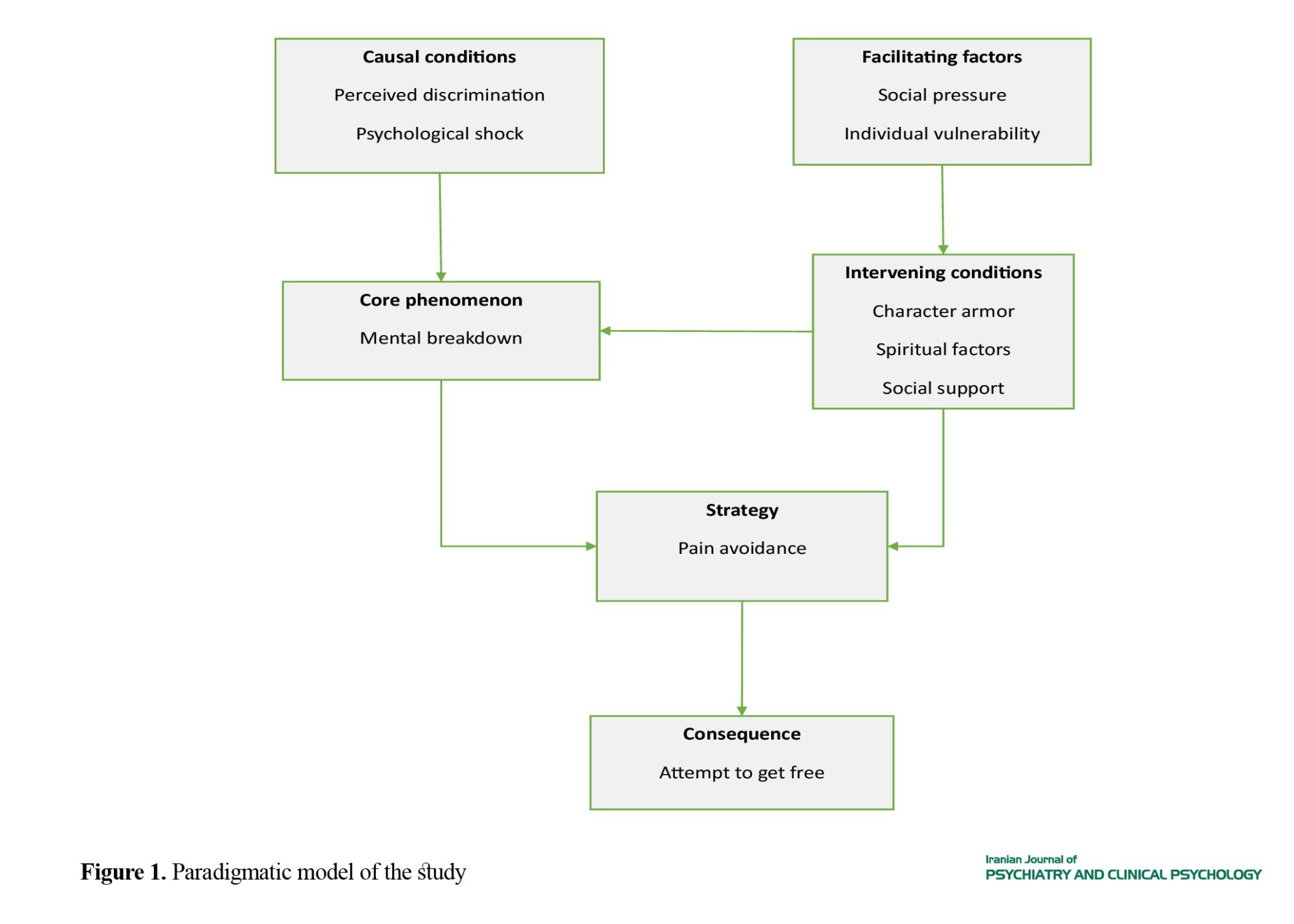
In this study, after analysis and coding, 134 concepts, 20 sub-themes, and 10 themes were extracted, which defined the study phenomenon (mental breakdown). Causal conditions leading to this phenomenon included perceived discrimination (comprising social frustration and stagnation) and psychological shock (encompassing emotional mixture and psychological pressure). Facilitating factors included social pressure (broken family, sociological tension, inefficient interpersonal relationships, and social stigma) and individual vulnerability (underlying physical/mental illness and unhealthy lifestyle). Intervening conditions included character armor (emotional and cognitive coping skills), spiritual factors (fear of death, religious beliefs, and worldview), and social support (support from family, friends, and professionals). The strategy adopted by participants was pain avoidance, which included the components of emotional, cognitive, and social escape. The consequence of this process was the “attempt to get free” by having passive and active suicidal behaviors. The paradigmatic model shown in Figure 1 shows the intertwining of the identified factors in the formation of the suicide attempt in Iranian youth.
Conclusion
The results of the present study indicate the important role of emotional, cognitive, and social factors in the process of suicide attempt in Iranian youth. The factors, including negative emotions such as emotional mixture, feeling discriminated, frustration, stagnation, and psychological pressure, can cause an individual to attempt suicide. The findings can be helpful in designing preventive, educational, and treatment methods to reduce the rate of suicide in Iranian youth.
Ethical Considerations
Compliance with ethical guidelines
This study has ethical approval from Shiraz University (Code: IR.US.PSYEDU.REC.1403.022). The participants were informed about the study objectives and methods, the confidentiality of their information, and their right to withdraw from the study. They signed an informed consent form.
Funding
This article was extracted from the dissertation of the first author at the Faculty of Education and Psychology, Shiraz University. The research was funded by the Iran National Elites Foundation (INEF).
Authors contributions
Conceptualization, Methodology, Validation, Writing–Original Draft, Data Curation, and Visualization: Fahime Mohamadpour; Formal Analysis, Investigation, Resources, Writing–Review & Editing, Supervision, and Project Administration: Nurallah Mohammadi.
Conflicts of interest
There is no conflict of interest.
Acknowledgments
The authors would like to thank all participants in this research.
Suicide is a psychological and social damage. It refers to a conscious act of self-harm with the intent to die. The strain of psychological conflicts causes people to commit suicide. Four main sources of strain that lead to suicide include value strain, aspiration strain, deprivation strain, and coping strain. Social and psychological studies have indicated the relationship of various factors such as social factors, mental disorders, and biological factors with suicide attempts and suicidal thoughts. Considering that a suicide can lead to the death of the person, the best plan to deal with it is to prevent a suicide attempt by identifying the early warning signs. Therefore, a deep understanding of this phenomenon is necessary in order to provide preventive and control solutions. In this regard, this research aimed to explore the process of suicide attempts in Iranian youth to identify the perceived pathological pattern.
Methods
This is a qualitative study based on the grounded theory approach. The participants, including 23 young people aged 18-35 years in Shiraz, Iran, with a history of suicide attempts during the last six months, were selected via purposeful sampling until reaching theoretical saturation. The exit criteria were acute cognitive disorders that affect the process of speaking and interviewing (such as acute cerebral palsy, dementia, and Alzheimer’s) and the lack of cooperation. To collect data, a semi-structured interview was employed. It included 10 questions set to survey the intended concepts. The data were analysed using Strauss and Corbin’s approach.
Results
In this study, after analysis and coding, 134 concepts, 20 sub-themes, and 10 themes were extracted, which defined the study phenomenon (mental breakdown). Causal conditions leading to this phenomenon included perceived discrimination (comprising social frustration and stagnation) and psychological shock (encompassing emotional mixture and psychological pressure). Facilitating factors included social pressure (broken family, sociological tension, inefficient interpersonal relationships, and social stigma) and individual vulnerability (underlying physical/mental illness and unhealthy lifestyle). Intervening conditions included character armor (emotional and cognitive coping skills), spiritual factors (fear of death, religious beliefs, and worldview), and social support (support from family, friends, and professionals). The strategy adopted by participants was pain avoidance, which included the components of emotional, cognitive, and social escape. The consequence of this process was the “attempt to get free” by having passive and active suicidal behaviors. The paradigmatic model shown in Figure 1 shows the intertwining of the identified factors in the formation of the suicide attempt in Iranian youth.
Conclusion
The results of the present study indicate the important role of emotional, cognitive, and social factors in the process of suicide attempt in Iranian youth. The factors, including negative emotions such as emotional mixture, feeling discriminated, frustration, stagnation, and psychological pressure, can cause an individual to attempt suicide. The findings can be helpful in designing preventive, educational, and treatment methods to reduce the rate of suicide in Iranian youth.
Ethical Considerations
Compliance with ethical guidelines
This study has ethical approval from Shiraz University (Code: IR.US.PSYEDU.REC.1403.022). The participants were informed about the study objectives and methods, the confidentiality of their information, and their right to withdraw from the study. They signed an informed consent form.
Funding
This article was extracted from the dissertation of the first author at the Faculty of Education and Psychology, Shiraz University. The research was funded by the Iran National Elites Foundation (INEF).
Authors contributions
Conceptualization, Methodology, Validation, Writing–Original Draft, Data Curation, and Visualization: Fahime Mohamadpour; Formal Analysis, Investigation, Resources, Writing–Review & Editing, Supervision, and Project Administration: Nurallah Mohammadi.
Conflicts of interest
There is no conflict of interest.
Acknowledgments
The authors would like to thank all participants in this research.
References
- Donyavi V, Rahnejat AM, Haghi A, Mohammadinia S, Jafari A. [Planning and implementing the program of assess, intervene, and monitor for suicide prevention among Iranian soldiers: An action research study (Persian)]. Iranian Journal of Psychiatry and Clinical Psychology. 2025; 31(1):2-17. [DOI:10.32598/ijpcp.30.4850.1]
- Turecki G, Brent DA, Gunnell D, O'Connor RC, Oquendo MA, Pirkis J, et al. Suicide and suicide risk. Nature Reviews. Disease Primers. 2019; 5(1):74. [DOI:10.1038/s41572-019-0121-0] [PMID]
- Zhang J. The strain theory of suicide. Journal of Pacific Rim Psychology. 2019; 13:e27. [DOI:10.1017/prp.2019.19]
- Zhang J, Liu Y, Sun L. Life satisfaction and degree of suicide intent: A test of the strain theory of suicide. Comprehensive Psychiatry. 2017; 74:1-8. [DOI:10.1016/j.comppsych.2016.12.002] [PMID]
- Reis Dana F. [Investigation of Iran social pathology (Persian)].Tehran: Iran Well-being Organization Publication; 2001. [Link]
- Perez-Smith A, Spirito A, Boergers J. Neighborhood predictors of hopelessness among adolescent suicide attempters: Preliminary investigation. Suicide & Life-Threatening Behavior. 2002; 32(2):139-45. [DOI:10.1521/suli.32.2.139.24400] [PMID]
- Sudol K, Mann JJ. Biomarkers of suicide attempt behavior: Towards a biological model of risk. Current Psychiatry Reports. 2017; 19(6):31. [DOI:10.1007/s11920-017-0781-y] [PMID]
- Brodsky BS, Oquendo M, Ellis SP, Haas GL, Malone KM, Mann JJ. The relationship of childhood abuse to impulsivity and suicidal behavior in adults with major depression. The American Journal of Psychiatry. 2001; 158(11):1871-7. [DOI:10.1176/appi.ajp.158.11.1871] [PMID]
- Miranda R, Jeglic EL. Correction to: Handbook of youth suicide prevention. In: Miranda R, Jeglic EL, editors. Handbook of youth suicide prevention. New York: Springer; 2023. [DOI:10.1007/978-3-030-82465-5_25]
- Joiner T. Why people die by suicide. Cambridge: Harvard University Press; 2005. [Link]
- Sun FK, Long A, Wang LJ, Tsai CS, Li CJ, Chiang CY. Explaining the family-centred care of young people with depressive disorders and suicidal ideations: A grounded theory study. Journal of Advanced Nursing. 2025; 81(5):2558-71. [DOI:10.1111/jan.16489] [PMID]
- Galynker I. The suicidal crisis: Clinical guide to the assessment of imminent suicide risk. Oxford: Oxford University Press; 2023. [DOI:10.1093/med/9780197582718.001.0001]
- Frey LM, Cerel J. Risk for suicide and the role of family: A narrative review. Journal of Family Issues. 2015; 36(6):716-36. [DOI:10.1177/0192513X13515885]
- Rogers ML, Gorday JY, Joiner TE. Examination of characteristics of ruminative thinking as unique predictors of suicide-related outcomes. Journal of Psychiatric Research. 2021; 139:1-7. [DOI:10.1016/j.jpsychires.2021.05.001] [PMID]
- Moradi MR, Salimi Bajestani H, Farahbakhsh K, Askari M, Borjali A. [Extracting a psychological model for the formation of suicidal ideation as social harm in students of University: A grounded theory study (Persian)]. Social Psychology Research. 2022; 11(44):23-46. [DOI:10.22034/spr.2022.297317.1667]
- Soroori S. [The lived experience of women attempting suicide; Case study: Langrod city (Persian)]. Tehran: Allameh Tabatabaei University; 2019. [Link]
- Zare Shahabadi A, Shafiee Nejad M, Madahi J. Suicidal behavior among women of Abdanan: Motivations and conditions. Woman in Development and Politics. 2017; 15(3):427-46. [DOI:10.22059/jwdp.2017.229631.1007164]
- Marcinkevičiūtė M, Vilutytė L, Gailienė D. Experience of pre-suicidal suffering: Insights from suicide attempt survivors. International Journal of Qualitative Studies on Health and Well-Being. 2024; 19(1):2370894. [DOI:10.1080/17482631.2024.2370894] [PMID]
- O’Connor RC, Kirtley OJ. The integrated motivational-volitional model of suicidal behaviour. Philosophical Transactions of the Royal Society B: Biological Sciences. 2018; 373(1754):20170268. [DOI:10.1098/rstb.2017.0268] [PMID]
- Heesen K, Mérelle S, van den Brand I, Van Bergen D, Baden D, Slotema K, et al. The forever decision: A qualitative study among survivors of a suicide attempt. EClinicalMedicine. 2024; 69. [DOI:10.1016/j.eclinm.2024.102449] [PMID]
- Reid HE, Pratt D, Edge D, Wittkowski A. What makes a perinatal woman suicidal? A grounded theory study. BMC psychiatry. 2022; 22(1):386. [DOI:10.1186/s12888-022-04015-w] [PMID]
- Assari S, Moghani Lankarani M, Caldwell CH. Discrimination increases suicidal ideation in black adolescents regardless of ethnicity and gender. Behavioral Sciences. 2017; 7(4):75. [DOI:10.3390/bs7040075] [PMID]
- Nock MK, Jaroszewski AC, Deming CA, Glenn CR, Millner AJ, Knepley M, et al. Antecedents, reasons for, and consequences of suicide attempts: Results from a qualitative study of 89 suicide attempts among army soldiers. Journal of Psychopathology and Clinical Science. 2025; 134(1):6-17. [DOI:10.1037/abn0000935] [PMID]
- Lawrence RE, Oquendo MA, Stanley B. Religion and suicide risk: A systematic review. Archives of Suicide Research. 2016; 20(1):1-21. [DOI:10.1080/13811118.2015.1004494] [PMID]
- Kleiman EM, Liu RT. Social support as a protective factor in suicide: Findings from two nationally representative samples. Journal of Affective Disorders. 2013; 150(2):540-5. [DOI:10.1016/j.jad.2013.01.033] [PMID]
- Johnson J, Gooding PA, Wood AM, Tarrier N. Resilience as positive coping appraisals: Testing the schematic appraisals model of suicide (SAMS). Behaviour Research and Therapy. 2010; 48(3):179-86. [DOI:10.1016/j.brat.2009.10.007] [PMID]
- Marshall P, Sansom K, Jagfeld G, Jones S, Lobban F. Caring for a friend or family member who has experienced suicidal behaviour: A systematic review and qualitative synthesis. Psychology and Psychotherapy: Theory, Research and Practice. 2023; 96(2):426-47. [DOI:10.1111/papt.12449] [PMID]
- Batterham PJ, Ftanou M, Pirkis J, Brewer JL, Mackinnon AJ, Beautrais A, et al. A systematic review and evaluation of measures for suicidal ideation and behaviors in population-based research. Psychological Assessment. 2015; 27(2):501. [DOI:10.1037/pas0000053] [PMID]
- Pollak OH, Sheehan AE, Walsh RFL, Stephenson AR, Zell H, Mayes J, et al. Assessment of suicidal thoughts and behaviors in adults: A systematic review of measure psychometric properties and implications for clinical and research utility. Clinical Psychology Review. 2024; 112:102464. [DOI:10.1016/j.cpr.2024.102464] [PMID]
- Etemadi Z, Abbaspour S, Tirgari A, Bagian Koulemarzi MJ. The mediating role of depression and hopelessness in the relationship of psychological strain, rejection sensitivity, and defeat with suicide ideation in adolescents in Iran. Iranian Journal of Psychiatry and Clinical Psychology. 2023; 29(2):170-87. [DOI:10.32598/ijpcp.29.2.2950.2]
- Hakim Shooshtari M, Khanipour H. [Comparison of Self-harm and Suicide Attempt in Adolescents: A Systematic Review (Persian)]. Iranian Journal of Psychiatry and Clinical Psychology. 2014; 20(1):3-13. [Link]
- Charmaz K. Constructing grounded theory. London: SAGE Publications; 2014. [Link]
- Strauss A,Corbin J. Basics of qualitative research: Techniques and procedures for developing grounded theory. Los Angeles: Sage Publications; 2014. [Link]
- Yang B, Guan Q, Huang J, Wang Z. Peer victimization and nonsuicidal self-injury among Chinese left-behind children: mediation by perceived discrimination and moderation by hardiness. Journal of Aggression, Maltreatment & Trauma. 2023; 32(5):709-25. [DOI:10.1080/10926771.2022.2101408]
Type of Study: Original Research |
Subject:
Psychiatry and Psychology
Received: 2024/12/23 | Accepted: 2025/09/13 | Published: 2025/10/10
Received: 2024/12/23 | Accepted: 2025/09/13 | Published: 2025/10/10
| Rights and permissions | |
 |
This work is licensed under a Creative Commons Attribution-NonCommercial 4.0 International License. |

Copyright © The Author(s);
This is an open access article distributed under the terms of the Creative Commons Attribution License (CC-By-NC), which permits use, distribution, and reproduction in any medium, provided the original work is properly cited and is not used for commercial purposes.
Contact Information