Wed, Aug 19, 2026
| فارسی
Volume 31, Issue 1 (Continuously Updated 2025)
IJPCP 2025, 31(1): 0-0 |
Back to browse issues page




Download citation:
BibTeX | RIS | EndNote | Medlars | ProCite | Reference Manager | RefWorks
Send citation to:


BibTeX | RIS | EndNote | Medlars | ProCite | Reference Manager | RefWorks
Send citation to:
Gholamnia R, Kolivand P H, Alishvandi R, Ahmadi H, Mamsharifi P. Mediating Role of Resilience and Adaptation in the Relationship Between Climate Change Anxiety and Mental Health: A Study in Six Provinces of Iran. IJPCP 2025; 31 (1)
URL: http://ijpcp.iums.ac.ir/article-1-4354-en.html
URL: http://ijpcp.iums.ac.ir/article-1-4354-en.html


1- Department of Health, Safety and Environment (HSE), School of Public Health and Safety, Shahid Beheshti University of Medical Sciences, Tehran, Iran.
2- Department of Health Economics, Faculty of Medicine, Shahed University, Tehran, Iran.
3- Deputy of International Affairs of Iranian Red Crescent, Tehran, Iran.
4- Head of Iranian Red Crescent Climate Center, Tehran, Iran.
5- Department of Psychology, Faculty of Psychology and Educational Sciences, Allameh Tabataba’i University, Tehran, Iran. & Research Center for Health Management in Mass Gathering, Red Crescent Society of the Islamic Republic of Iran, Tehran, Iran. & Research Center for Emergency and Disaster Resilience, Red Crescent Society of the Islamic Republic of Iran, Tehran, Iran. ,peymanmamsharifi@gmail.com
2- Department of Health Economics, Faculty of Medicine, Shahed University, Tehran, Iran.
3- Deputy of International Affairs of Iranian Red Crescent, Tehran, Iran.
4- Head of Iranian Red Crescent Climate Center, Tehran, Iran.
5- Department of Psychology, Faculty of Psychology and Educational Sciences, Allameh Tabataba’i University, Tehran, Iran. & Research Center for Health Management in Mass Gathering, Red Crescent Society of the Islamic Republic of Iran, Tehran, Iran. & Research Center for Emergency and Disaster Resilience, Red Crescent Society of the Islamic Republic of Iran, Tehran, Iran. ,
Full-Text [PDF 5703 kb]
(650 Downloads)
| Abstract (HTML) (1014 Views)
Full-Text: (588 Views)
Introduction
Climate change refers to long-term changes in weather elements such as temperature and precipitation, primarily resulting from human activities, such as burning fossil fuels. These changes have negative impacts on individuals’ mental health. Mental health refers to effective interaction with others and dealing with conflicts. Research has shown that mental health is significantly affected by climate change. Climate change anxiety refers to the distress and worry due to the impact of climate change and having concerns about the future, which can directly and indirectly affect mental health through resilience and adaptation. Resilience is defined as an individual’s ability to cope with stress and challenges, and can act as a protective factor against the negative effects of anxiety. Adaptation is the ability to adapt to new environments and conditions and can help mitigate climate change anxiety. The present study aims to develop a model to examine the mediating role of resilience and adaptation in the relationship between climate change anxiety and mental health.
Methods
This is a correlational study using structural equation modeling (SEM). The study population consisted of all members of the Iranian Red Crescent Society in six provinces of Iran affected by climate change in 2024: Khuzestan, Hormozgan, Ilam, Kerman, Sistan & Baluchestan, and South Khorasan. Sampling was conducted using cluster random sampling and convenience sampling methods. Ten cities were selected from each province, and 25 questionnaires were distributed to each city. Of 1500 questionnaires, 1196 were deemed suitable for analysis. The inclusion criteria were informed consent to participate in the study, residency in the specified province, and not having consulted a psychologist or psychiatrist in the past year. The exclusion criteria were the unwillingness to continue participation in the study and the failure to answer more than five percent of questions. To gather data, the 25-item symptom checklist, the eco-anxiety scale, the Connor-Davidson resilience scale, and the adaptation questionnaire were utilized. In the adaptation questionnaire, symptom checklist, and eco-anxiety scale, a higher score indicates worse and more severe conditions. Pearson’s correlation test and SEM were employed to examine causal relationships among the variables. The results were analyzed in SPSS software, version 24 and Amos software, version 24.
Results
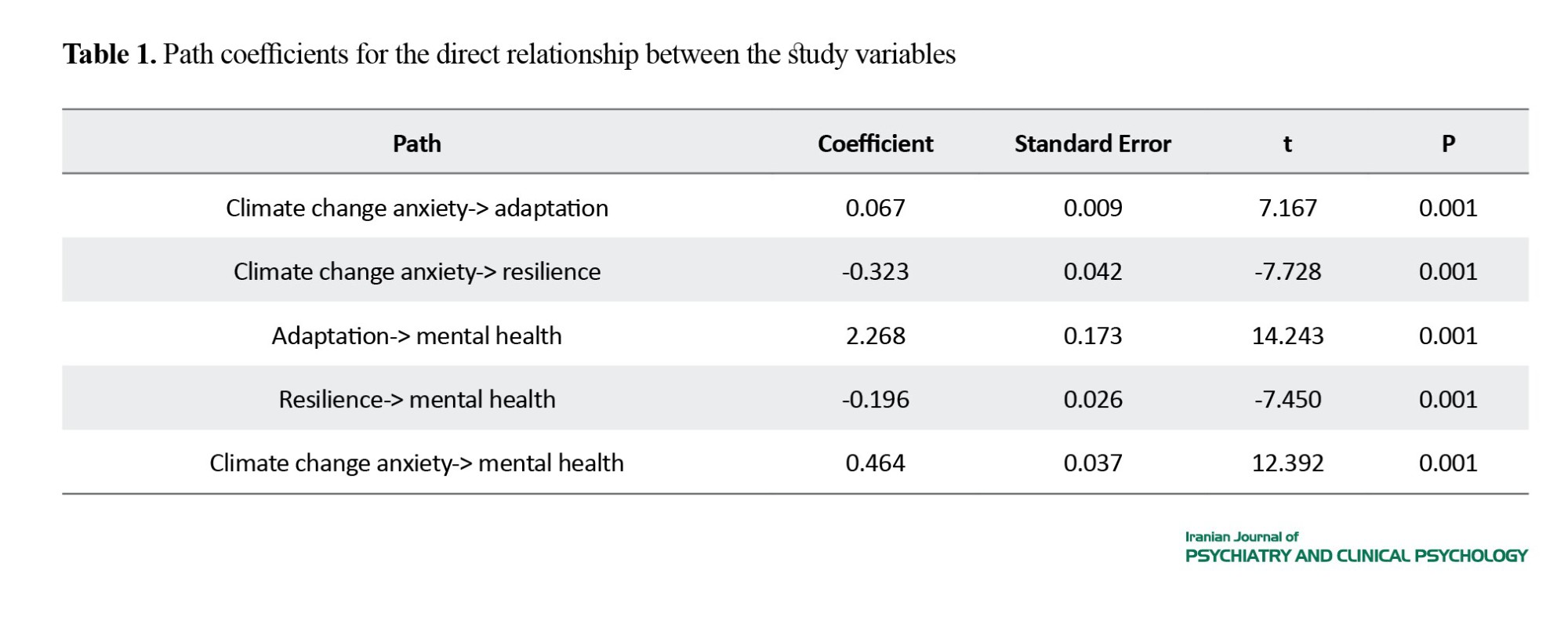
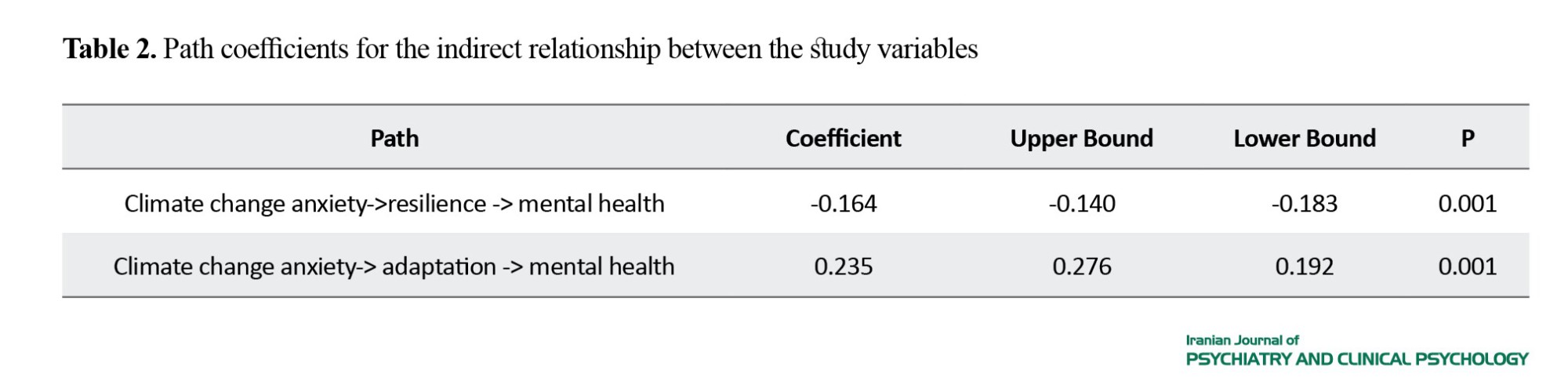
In this study, 1196 Iranian people participated. Their mean age was 33.25 years. In terms of educational levels, 177(14.8%) had lower than high school education, 350(29.3%) had a high school diploma, 132 (11%) had an associate degree, 455(38%) had a bachelor’s degree, and 82(6.9%) had PhD degrees. There was a significant positive relationship between climate change anxiety and mental health (P<0.01, r=0.41) and between adaptation and mental health (P<0.01, r=0.57), while a significant negative relationship was observed between resilience and mental health (P<0.01, r=-0.39). As presented in Tables 1 and 2, the indirect effect of climate change anxiety on mental health was significant through adaptation and resilience (P<0.001). Therefore, the findings of the research indicate that climate change anxiety can predict mental health both directly and indirectly through resilience and adaptation.
Conclusion
Climate change anxiety has significant negative effects on Iranian people’s mental health. In addition, the feelings caused by this anxiety can lead to a decrease in resilience and adaptation, which ultimately weakens the ability of people to adapt to new conditions. Therefore, it is necessary to pay attention to the psychological and social needs of people and provide support to reduce their anxiety related to climate change, so that they can adapt to the challenges more effectively. Considering the negative impact of climate change anxiety and the role of resilience and adaptation as mediating variables, it seems that strengthening resilience and adaptation can effectively improve the mental health of people.
Ethical Considerations
Compliance with ethical guidelines
Ethical approval was obtained from the Research Ethics Committee of the Iranian Red Crescent Society (Code: IR.RCS.REC.1403.044). People participated in this research voluntarily, and their information was kept confidential.
Funding
This research was extracted from a research project approved by the Deputy for Education, Research, and Technology of the Iranian Red Crescent Society.
Authors contributions
Investigation: Reza Gholamnia, Peyman Mamsharifi, Hadi Ahmadi; Supervision, review & editing: Pir Hossein Kolivand and Razieh Alishvandi; Data analysis: Peyman Mamsharifi.
Conflicts of interest
The authors declared no conflict of interest.
Acknowledgments
The authors would like to thank all participants for their cooperation in this study.
Climate change refers to long-term changes in weather elements such as temperature and precipitation, primarily resulting from human activities, such as burning fossil fuels. These changes have negative impacts on individuals’ mental health. Mental health refers to effective interaction with others and dealing with conflicts. Research has shown that mental health is significantly affected by climate change. Climate change anxiety refers to the distress and worry due to the impact of climate change and having concerns about the future, which can directly and indirectly affect mental health through resilience and adaptation. Resilience is defined as an individual’s ability to cope with stress and challenges, and can act as a protective factor against the negative effects of anxiety. Adaptation is the ability to adapt to new environments and conditions and can help mitigate climate change anxiety. The present study aims to develop a model to examine the mediating role of resilience and adaptation in the relationship between climate change anxiety and mental health.
Methods
This is a correlational study using structural equation modeling (SEM). The study population consisted of all members of the Iranian Red Crescent Society in six provinces of Iran affected by climate change in 2024: Khuzestan, Hormozgan, Ilam, Kerman, Sistan & Baluchestan, and South Khorasan. Sampling was conducted using cluster random sampling and convenience sampling methods. Ten cities were selected from each province, and 25 questionnaires were distributed to each city. Of 1500 questionnaires, 1196 were deemed suitable for analysis. The inclusion criteria were informed consent to participate in the study, residency in the specified province, and not having consulted a psychologist or psychiatrist in the past year. The exclusion criteria were the unwillingness to continue participation in the study and the failure to answer more than five percent of questions. To gather data, the 25-item symptom checklist, the eco-anxiety scale, the Connor-Davidson resilience scale, and the adaptation questionnaire were utilized. In the adaptation questionnaire, symptom checklist, and eco-anxiety scale, a higher score indicates worse and more severe conditions. Pearson’s correlation test and SEM were employed to examine causal relationships among the variables. The results were analyzed in SPSS software, version 24 and Amos software, version 24.
Results
In this study, 1196 Iranian people participated. Their mean age was 33.25 years. In terms of educational levels, 177(14.8%) had lower than high school education, 350(29.3%) had a high school diploma, 132 (11%) had an associate degree, 455(38%) had a bachelor’s degree, and 82(6.9%) had PhD degrees. There was a significant positive relationship between climate change anxiety and mental health (P<0.01, r=0.41) and between adaptation and mental health (P<0.01, r=0.57), while a significant negative relationship was observed between resilience and mental health (P<0.01, r=-0.39). As presented in Tables 1 and 2, the indirect effect of climate change anxiety on mental health was significant through adaptation and resilience (P<0.001). Therefore, the findings of the research indicate that climate change anxiety can predict mental health both directly and indirectly through resilience and adaptation.
Conclusion
Climate change anxiety has significant negative effects on Iranian people’s mental health. In addition, the feelings caused by this anxiety can lead to a decrease in resilience and adaptation, which ultimately weakens the ability of people to adapt to new conditions. Therefore, it is necessary to pay attention to the psychological and social needs of people and provide support to reduce their anxiety related to climate change, so that they can adapt to the challenges more effectively. Considering the negative impact of climate change anxiety and the role of resilience and adaptation as mediating variables, it seems that strengthening resilience and adaptation can effectively improve the mental health of people.
Ethical Considerations
Compliance with ethical guidelines
Ethical approval was obtained from the Research Ethics Committee of the Iranian Red Crescent Society (Code: IR.RCS.REC.1403.044). People participated in this research voluntarily, and their information was kept confidential.
Funding
This research was extracted from a research project approved by the Deputy for Education, Research, and Technology of the Iranian Red Crescent Society.
Authors contributions
Investigation: Reza Gholamnia, Peyman Mamsharifi, Hadi Ahmadi; Supervision, review & editing: Pir Hossein Kolivand and Razieh Alishvandi; Data analysis: Peyman Mamsharifi.
Conflicts of interest
The authors declared no conflict of interest.
Acknowledgments
The authors would like to thank all participants for their cooperation in this study.
References
- Muruganandam M, Rajamanickam S, Sivarethinamohan S, Gaddam MKR, Velusamy P, Gomathi R, et al. Impact of climate change and anthropogenic activities on aquatic ecosystem-A review. Environmental Research. 2023; 238(Pt 2):117233. [DOI:10.1016/j.envres.2023.117233] [PMID]
- Abrahms B, Carter NH, Clark-Wolf T, Gaynor KM, Johansson E, McInturff A, et al. Climate change as a global amplifier of human-wildlife conflict. Nature Climate Change. 2023; 13(3):224-34. [DOI:10.1038/s41558-023-01608-5]
- Nielsen KS, Cologna V, Lange F, Brick C, Stern PC. The case for impact-focused environmental psychology. Journal of Environmental Psychology. 2021; 74:101559. [DOI:10.1016/j.jenvp.2021.101559]
- Steg L. Psychology of climate change. Annual Review of Psychology. 2023; 74(1):391-421. [DOI:10.1146/annurev-psych-032720-042905] [PMID]
- Seiferth C, Vogel L, Aas B, Brandhorst I, Carlbring P, Conzelmann A, et al. How to e-mental health: A guideline for researchers and practitioners using digital technology in the context of mental health. Nature Mental Health. 2023; 1(8):542-54. [DOI:10.1038/s44220-023-00085-1]
- Zwar L, König HH, Hajek A. Gender differences in mental health, quality of life, and caregiver burden among informal caregivers during the second wave of the COVID-19 Pandemic in Germany: A representative, population-based study. Gerontology. 2023; 69(2):149-62. [DOI:10.1159/000523846] [PMID]
- Wolff B, Magiati I, Roberts R, Pellicano E, Glasson EJ. Risk and resilience factors impacting the mental health and wellbeing of siblings of individuals with neurodevelopmental conditions: A mixed methods systematic review. Clinical Psychology Review. 2022; 98:102217. [DOI:10.1016/j.cpr.2022.102217] [PMID]
- Ten Have M, Tuithof M, van Dorsselaer S, Schouten F, Luik AI, de Graaf R. Prevalence and trends of common mental disorders from 2007-2009 to 2019-2022: Results from the Netherlands Mental Health Survey and Incidence Studies (NEMESIS), including comparison of prevalence rates before vs. during the COVID-19 pandemic. World Psychiatry. 2023; 22(2):275-85. [DOI:10.1002/wps.21087] [PMID]
- Schwartz SE, Benoit L, Clayton S, Parnes MF, Swenson L, Lowe SR. Climate change anxiety and mental health: Environmental activism as buffer. Current Psychology. 2022 ; 1-14. [DOI:10.1007/s12144-022-02735-6] [PMID]
- Gunasiri H, Wang Y, Watkins EM, Capetola T, Henderson-Wilson C, Patrick R. Hope, Coping and Eco-Anxiety: Young people's mental health in a climate-impacted Australia. International Journal of Environmental Research and Public Health. 2022; 19(9):5528. [DOI:10.3390/ijerph19095528] [PMID]
- Clayton S. Climate anxiety: Psychological responses to climate change. Journal of Anxiety Disorders. 2020; 74:102263. [DOI:10.1016/j.janxdis.2020.102263] [PMID]
- Ungar M, Theron L. Resilience and mental health: How multisystemic processes contribute to positive outcomes. The Lancet Psychiatry. 2020; 7(5):441-8. [DOI:10.1016/S2215-0366(19)30434-1] [PMID]
- Seiler A, Jenewein J. Resilience in cancer patients. Frontiers in Psychiatry. 2019; 10:208. [DOI:10.3389/fpsyt.2019.00208] [PMID]
- Dai Q, Smith GD. Resilience to depression: Implication for psychological vaccination. Frontiers in Psychiatry. 2023; 14:1071859. [DOI:10.3389/fpsyt.2023.1071859] [PMID]
- Conz E, Magnani G. A dynamic perspective on the resilience of firms: A systematic literature review and a framework for future research. European Management Journal. 2020; 38(3):400-12. [DOI:10.1016/j.emj.2019.12.004]
- Chen S, Bagrodia R, Pfeffer CC, Meli L, Bonanno GA. Anxiety and resilience in the face of natural disasters associated with climate change: A review and methodological critique. Journal of Anxiety Disorders. 2020; 76:102297. [DOI:10.1016/j.janxdis.2020.102297] [PMID]
- Sims L, Rocque R, Desmarais M-É. Enabling students to face the environmental crisis and climate change with resilience: inclusive environmental and sustainability education approaches and strategies for coping with eco-anxiety. International Journal of Higher Education and Sustainability. 2020; 3(2):112-31. [DOI:10.1504/IJHES.2020.113059]
- Abunyewah M, Erdiaw-Kwasie MO, Acheampong AO, Arhin P, Okyere SA, Zanders K, et al. Understanding climate change adaptation in Ghana: The role of climate change anxiety, experience, and knowledge. Environmental Science & Policy. 2023; 150:103594. [DOI:10.1016/j.envsci.2023.103594]
- Minchekar Vikas S, Mangore Nivrutti D. Home emotional and social adjustment and mental health among hostel students. Think India Journal. 2019; 22(38):31-6. [Link]
- Dauth W, Findeisen S, Suedekum J, Woessner N. The adjustment of labor markets to robots. Journal of the European Economic Association. 2021; 19(6):3104-53. [DOI:10.1093/jeea/jvab012]
- Mortreux C, Barnett J, Jarillo S, Greenaway KH. Reducing personal climate anxiety is key to adaptation. Nature Climate Change. 2023; 13(7):590. [DOI:10.1038/s41558-023-01716-2]
- Hurley EA, Dalglish SL, Sacks E. Supporting young people with climate anxiety: Mitigation, adaptation, and resilience. The Lancet Planetary Health. 2022; 6(3):e190. [DOI:10.1016/S2542-5196(22)00015-8] [PMID]
- Verdolini N, Amoretti S, Montejo L, García-Rizo C, Hogg B, Mezquida G, et al. Resilience and mental health during the COVID-19 pandemic. Journal of Affective Disorders. 2021; 283:156-64. [DOI:10.1016/j.jad.2021.01.055] [PMID]
- Jeong J, Nam S. Internal resources, adjustment, and mental health among Asian international students: A Structural Equation Model. Journal of Asia Pacific Counseling. 2023; 13(1):131-47. [Link]
- Kline RB. Principles and practice of structural equation modeling. New York: Guilford Publications; 2023. [Link]
- Sohrabi F, Mamsharifi P, Rafezi Z, A’azami Y. [Predicting addiction potential based on mental health, social support and neuroticism and agreeableness personality traits (Persian)]. Iranian Journal of Psychiatric Nursing. 2019; 6(6):57-66. [DOI:10.21859/ijpn-06067]
- Reshvanloo FT, Saadati Shamir A. Construct validity and reliability of Symptom Checklist-25 (SCL-25). Journal of Fundamentals of Mental Health. 2015; 18(1):48-56. [Link]
- Hogg TL, Stanley SK, O’Brien LV, Wilson MS, Watsford CR. The Hogg Eco-Anxiety Scale: Development and validation of a multidimensional scale. Global Environmental Change. 2021; 71:102391. [DOI:10.1016/j.gloenvcha.2021.102391]
- Connor KM, Davidson JR. Development of a new resilience scale: The Connor-Davidson resilience scale (CD-RISC). Depression and Anxiety. 2003; 18(2):76-82. [DOI:10.1002/da.10113] [PMID]
- Ahangarzadeh Rezaei S. [Psychometric properties of the Persian version of (Persian)]. Nursing and Midwifery Journal. 2015; 13(9):739-47. [Link]
- Paktinatan E, Chinaveh M, Fereydouni S. The effectiveness of acceptance and commitment group therapy with a look at compassion therapy in cognitive regulation of negative emotions and social adjustment in patients with major depressive disorder. Applied Family Therapy Journal. 2022; 3(1):263-84. [DOI:10.61838/kman.aftj.3.1.14]
- Chou CP, Bentler PM. Estimates and tests in structural equation modeling. In: Hoyle RH, editor. Structural equation modeling: Concepts, issues, and applications. California: Sage Publications, Inc; 1995. [Link]
- Cianconi P, Betrò S, Janiri L. The impact of climate change on mental health: A systematic descriptive review. Frontiers in Psychiatry. 2020; 11:74. [DOI:10.3389/fpsyt.2020.00074] [PMID]
- Léger-Goodes T, Malboeuf-Hurtubise C, Mastine T, Généreux M, Paradis PO, Camden C. Eco-anxiety in children: A scoping review of the mental health impacts of the awareness of climate change. Frontiers in Psychology. 2022; 13:872544. [DOI:10.3389/fpsyg.2022.872544] [PMID]
- Schwaab L, Gebhardt N, Friederich HC, Nikendei C. Climate change related depression, anxiety and stress symptoms perceived by medical students. International Journal of Environmental Research and Public Health. 2022; 19(15):9142. [DOI:10.3390/ijerph19159142] [PMID]
- Palinkas LA, Wong M. Global climate change and mental health. Current Opinion in Psychology. 2020; 32:12-6. [DOI:10.1016/j.copsyc.2019.06.023] [PMID]
Type of Study: Original Research |
Subject:
Psychiatry and Psychology
Received: 2024/11/4 | Accepted: 2025/05/11 | Published: 2025/08/1
Received: 2024/11/4 | Accepted: 2025/05/11 | Published: 2025/08/1
| Rights and permissions | |
 |
This work is licensed under a Creative Commons Attribution-NonCommercial 4.0 International License. |

Copyright © The Author(s);
This is an open access article distributed under the terms of the Creative Commons Attribution License (CC-By-NC), which permits use, distribution, and reproduction in any medium, provided the original work is properly cited and is not used for commercial purposes.
Contact Information